


Quick Answer
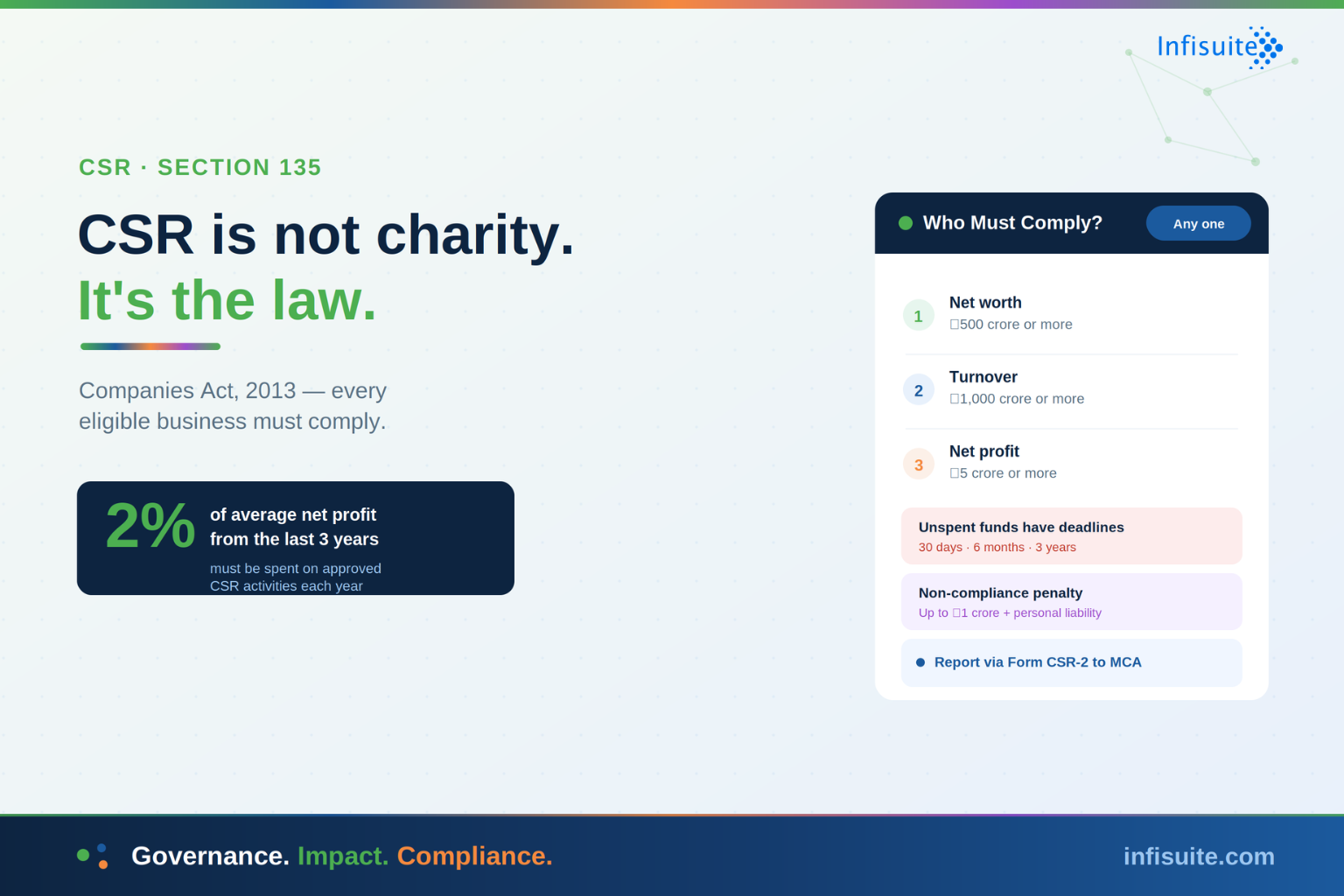
CSR under Section 135 of the Companies Act, 2013 is the legal duty for eligible Indian companies to spend at least 2% of their average net profits from the last three years on approved social activities. Companies qualify if they meet any one of three thresholds: net worth of ₹500 crore or more, turnover of ₹1,000 crore or more, or net profit of ₹5 crore or more in the preceding financial year. Qualifying companies must form a CSR Committee, adopt a CSR policy, spend on activities listed in Schedule VII, report in the Board's report, and file Form CSR-2 with the MCA. Non-compliance can attract penalties up to ₹1 crore.
Key Takeaways
- CSR is a legal duty in India, not a voluntary act. Section 135 makes it mandatory for qualifying companies.
- Three thresholds decide who must comply — net worth ₹500 cr, turnover ₹1,000 cr, or net profit ₹5 cr. Meeting any one triggers CSR.
- The rule is 2% of average net profits from the last three financial years, calculated under Section 198.
- Only Schedule VII activities qualify — education, healthcare, environment, poverty relief, and more.
- Unspent CSR funds have strict deadlines — 30 days, 6 months, or 3 years, depending on the case.
- Penalties under Section 135(7) are severe — up to ₹1 crore for the company, plus personal penalties for officers.
Corporate Social Responsibility is one of the most misunderstood laws in Indian business.
Many people think of it as charity. It is not. Under Section 135 of the Companies Act, 2013, CSR is a legal obligation. Qualifying companies must spend a fixed percentage of their profits on approved social activities every year, or face real penalties.
This guide explains what Section 135 says, who it applies to, how much you must spend, what counts as CSR, and what happens if you get it wrong. In plain English, with current 2026 rules.
What Is CSR Under Section 135?
CSR stands for Corporate Social Responsibility. In India, it is defined by Section 135 of the Companies Act, 2013, backed by the Companies (CSR Policy) Rules, 2014.
The law says that eligible companies must spend at least 2% of their average net profits on activities that benefit society. Not marketing. Not employee welfare. Not the normal course of business. Real, measurable social work.
India was the first country in the world to make CSR a statutory duty. That was in 2013. Since then, the rules have grown stricter, with more focus on real impact and audit-ready reporting.
Who Must Comply With Section 135?
Section 135 applies to a company if it meets any one of three financial thresholds in the previous financial year.
| Threshold | Amount | Applies to |
|---|---|---|
| Net worth | ₹500 crore or more | Any registered company |
| Turnover | ₹1,000 crore or more | Any registered company |
| Net profit | ₹5 crore or more | Any registered company |
Meet any one, and CSR becomes a legal duty. This is true for both Indian companies and foreign companies operating in India through a branch or project office.
If a company falls below all three thresholds for three straight years, it exits the CSR obligation until it crosses one again.
The 2% Rule: How Much Must You Spend?
The law is clear. Eligible companies must spend at least 2% of the average net profit earned during the three financial years preceding the current one.
Here is a simple example.
Example: CSR Calculation
Net profit — FY 2022–23: ₹10 crore
Net profit — FY 2023–24: ₹12 crore
Net profit — FY 2024–25: ₹14 crore
Average of last three years = ₹12 crore
CSR obligation for FY 2025–26 = 2% of ₹12 crore = ₹24 lakh
The 2% is calculated on net profit as defined in Section 198 of the Companies Act. This is different from taxable profit or accounting profit. Specific adjustments apply, such as excluding dividend income from other Indian companies and profits from overseas branches. Always confirm the correct figure with your finance team.
If you spend less than the required amount, you must give a reason in the Board's report. Unspent amounts have strict handling rules (see below).
What Counts as CSR? Schedule VII Explained
Not every social activity qualifies as CSR. The Companies Act specifies eligible activities in Schedule VII. If your spend does not fall under one of these heads, it is not counted as CSR.
The main Schedule VII activities include:
- Eradicating hunger, poverty, and malnutrition
- Promoting healthcare, including preventive healthcare and sanitation
- Promoting education, including special education and vocational skills
- Promoting gender equality and empowering women
- Ensuring environmental sustainability
- Protection of national heritage, art, and culture
- Measures for the benefit of armed forces veterans and their families
- Training in sports, including rural, nationally recognised, and Olympic sports
- Contribution to the Prime Minister's National Relief Fund and similar funds
- Rural development projects
- Slum area development
- Disaster management, including relief, rehabilitation, and reconstruction
What Does NOT Qualify as CSR: Normal business activity, employee benefits, political contributions, one-off marketing or brand sponsorships, and activities undertaken outside India (except specific approved cases such as training Indian sports personnel abroad).
The CSR Committee and CSR Policy
Section 135 requires eligible companies to form a CSR Committee of the Board. This committee designs, plans, and monitors the CSR programme.
Rules for the committee:
- Must have at least three directors, one of whom is an independent director.
- If the CSR obligation is less than ₹50 lakh, only two directors are required and no independent director is mandatory.
- The committee recommends the CSR policy, activities, budget, and monitors implementation.
The CSR Policy is a Board-approved document. It must set out the approach, activities, budget, monitoring process, and impact measurement. The policy must be published on the company's website.
Ongoing Projects and Unspent CSR Funds
What happens if you cannot spend the full 2% in one financial year? The rules depend on the type of project.
| Situation | What You Must Do | Deadline |
|---|---|---|
| Unspent from an ongoing project | Transfer to Unspent CSR Account (scheduled bank) | Within 30 days of FY-end |
| Balance in Unspent CSR Account | Spend on the designated project | Within 3 financial years |
| Unspent not tied to an ongoing project | Transfer to a Schedule VII fund (e.g. PM Relief Fund) | Within 6 months of FY-end |
| Still unspent after 3 years (ongoing) | Transfer to a Schedule VII fund | Within 30 days of the 3-year period ending |
These rules are strict. Missing a deadline means the money is legally lost — you have to transfer it to a government fund, and the company gets no CSR credit.
Reporting: Board's Report, Form CSR-2, and Impact Assessment
Compliance does not end with spending. You must also report — accurately, on time, and with an audit trail.
1. Board's Report Annexure
The Board's report must include a detailed annexure on CSR. This covers policy, committee, activities undertaken, amount spent, unspent amount, and reasons for any shortfall.
2. Form CSR-2
Every qualifying company must file Form CSR-2 with the Ministry of Corporate Affairs each year. This is the formal disclosure of CSR activity, filed as an addendum to Form AOC-4 or AOC-4 XBRL. Filing is mandatory even if the company has spent the full 2%.
3. Impact Assessment (for larger companies)
If your average CSR obligation is ₹10 crore or more over the last three financial years, you must commission an independent impact assessment for any project with an outlay of ₹1 crore or more, at least one year after completion. The assessment must be done by an independent agency and attached to the Board's report.
4. Implementing Agencies and CSR-1
Most CSR is delivered through implementing agencies — NGOs, trusts, or Section 8 companies. From 2021, every implementing agency must register with the MCA by filing Form CSR-1. Your company must verify this registration before disbursing funds — the legal liability sits with you, not the partner.
Penalties for Non-Compliance Under Section 135(7)
Section 135 has real teeth. The Companies (Amendment) Act, 2020 introduced statutory penalties for non-compliance under Section 135(7).
- For the company: Penalty of twice the unspent amount, or ₹1 crore, whichever is less.
- For officers in default: Personal penalty of one-tenth of the unspent amount, or ₹2 lakh, whichever is less.
- For failure to transfer unspent funds: Additional penalty of ₹50,000, extending to ₹25 lakh, plus daily interest and legal notices from the Registrar of Companies.
Directors, CFOs, and Company Secretaries can be held personally liable. This is why CSR is now treated as a compliance function on par with financial reporting, not a "nice to do" activity.
How CSR Software Helps
Managing all of this in spreadsheets is possible, but it is risky. Each year adds committee minutes, budgets, project reports, partner records, utilisation certificates, impact assessments, and MCA filings. The audit trail grows too large to hold in files and emails.
CSR software fixes this by keeping everything in one connected system:
- Tracks the 2% mandate — calculates the required spend under Section 198, tracks actual spend, and flags shortfalls before deadlines.
- Manages the CSR Committee workflow — proposals, reviews, approvals, and decisions with a full audit trail.
- Tags every project to Schedule VII — so spend is always defensible at audit.
- Verifies partner CSR-1 registration — before funds are released.
- Handles unspent fund tracking — with alerts on 30-day, 6-month, and 3-year deadlines.
- Generates ready-to-file reports — Board's report annexure, Form CSR-2 data, and impact assessment records.
The similarities with payroll compliance are striking. Both are statutory. Both have monthly or annual deadlines. Both have serious penalties. And both benefit from automation for the same reasons — accuracy, audit-readiness, and freeing up your team's time.
Infisuite CSR Software is built specifically for Section 135 compliance. It covers the complete lifecycle — from need identification and proposal creation, through committee review and approvals, budget allocation, fund release, project execution, milestone tracking, financial closure, and impact assessment — on one integrated platform. For growing organisations, this is the same kind of shift as outgrowing spreadsheets in any other area: eventually the manual work becomes bigger than the software cost.
Frequently Asked Questions
What is CSR under Section 135?
CSR under Section 135 of the Companies Act, 2013 is the legal duty of eligible Indian companies to spend at least 2% of average net profits from the last three years on approved social activities. The activities must fall under Schedule VII, be governed by a CSR Committee, and be reported to the Ministry of Corporate Affairs.
Which companies must comply with Section 135?
Any company that meets any one of three thresholds in the previous financial year — net worth of ₹500 crore or more, turnover of ₹1,000 crore or more, or net profit of ₹5 crore or more. Both Indian and foreign companies operating in India are covered.
What is the 2% CSR rule?
Eligible companies must spend at least 2% of their average net profit from the last three financial years on Schedule VII activities each year. Net profit is calculated as per Section 198 of the Companies Act, not the taxable or accounting profit.
What activities qualify as CSR under Schedule VII?
Schedule VII lists approved activities including education, healthcare, poverty relief, gender equality, environmental sustainability, rural development, disaster management, and contributions to specified government funds. Normal business, marketing, employee benefits, and political contributions do not qualify.
What happens if a company does not spend the full 2%?
Unspent amounts tied to ongoing projects must be transferred to an Unspent CSR Account within 30 days and used within three years. Other unspent amounts must be transferred to a Schedule VII government fund within six months. Non-compliance can attract penalties up to ₹1 crore for the company plus personal penalties for officers.
Is Form CSR-2 filing mandatory every year?
Yes. Every company that meets the Section 135 thresholds must file Form CSR-2 with the MCA each year, filed as an addendum to Form AOC-4, even if it has fully spent the required amount.
When is impact assessment mandatory?
When your average CSR obligation is ₹10 crore or more over the last three financial years, you must commission an independent impact assessment for any project of ₹1 crore or more, at least one year after completion. The report must be attached to the Board's report.
Can foreign companies be subject to Section 135?
Yes. Foreign companies operating in India through a branch, project office, or subsidiary must comply if they meet any of the three thresholds.
Conclusion
CSR is no longer a matter of goodwill. Under Section 135, it is a statutory duty with clear thresholds, strict deadlines, and real penalties. If your company qualifies, the 2% spend, Schedule VII tagging, CSR Committee governance, unspent-fund tracking, and MCA filings are all mandatory — not optional.
The direction of the law is unmistakable: from spend to outcomes, from paperwork to verified impact. Manual tracking that worked five years ago is no longer enough. Purpose-built CSR software makes the compliance simple, the reporting audit-ready, and the impact measurable.
Get CSR right, and you build trust with regulators, boards, and communities. Get it wrong, and the cost is measured in penalties, personal liability, and reputational risk. Section 135 is where every eligible business should start.
Written by Anjana A
ERP & Business Software Specialist, Infisuite
Anjana A writes about ERP, CSR, and business compliance for growing Indian enterprises. She focuses on clear, practical guidance that helps businesses navigate statutory obligations without getting lost in legal jargon.
Ready to make Section 135 compliance simple? Talk to the Infisuite team to see Infisuite CSR Software in action.