

Quick Answer
Payroll compliance means following all the laws that apply when you pay employees. In India, this mainly covers four statutory items: PF (Provident Fund), ESI (Employees’ State Insurance), TDS (Tax Deducted at Source), and Professional Tax. Each has its own rate, threshold, and deadline. You must calculate the right amount, deduct it, deposit it on time, and file the correct returns. Missing a deadline or getting a number wrong can lead to interest, penalties, and legal trouble. The safest way to stay compliant is to automate these calculations inside connected payroll software, so every deduction is correct and every deadline is met.
Key Takeaways
- Payroll compliance = following the law when you pay staff. In India, that means PF, ESI, TDS, and Professional Tax.
- Each has a threshold. PF applies at 20+ employees. ESI applies at 10+ and covers staff earning up to ₹21,000 gross.
- Deadlines are strict. Most deposits are due by the 15th of the next month. Late payment adds interest.
- Penalties are real. Errors can cost ₹10,000 to ₹1 lakh per violation, plus interest.
- Automation removes the risk. Connected payroll software calculates, deducts, and files correctly, every month.
Paying your team is simple. Paying them legally is not.
Every month, Indian employers must deduct the right statutory amounts, deposit them on time, and file the right returns. Get it wrong, and the cost is real: interest, penalties, and inspections.
This guide explains payroll compliance in plain English. You will learn what PF, ESI, and TDS are. You will see the current rates and deadlines. And you will learn the easiest way to stay compliant.
What Is Payroll Compliance?
Payroll compliance means following all the rules that apply when you pay employees.
It is not just about paying salaries. It is about the deductions and filings that go with them. In India, the main statutory items are PF, ESI, TDS, and Professional Tax.
For each one, you must do four things:
- Calculate the correct amount.
- Deduct it from the right employees.
- Deposit it with the government on time.
- File the required return.
Miss any step, and you are non-compliant. That is where the risk begins.
The 4 Main Payroll Compliance Items in India
1. PF — Provident Fund (EPF)
PF is a retirement savings scheme managed by the Employees’ Provident Fund Organisation (EPFO). Both the employee and employer contribute.
- Employee pays 12% of Basic + DA.
- Employer pays 12% too. This splits into 3.67% for EPF and 8.33% for pension (EPS).
- PF applies to businesses with 20 or more employees.
- It is mandatory for staff earning Basic + DA up to ₹15,000. Above that, contribution can be capped at ₹15,000.
- Deposit is due by the 15th of the next month.
2. ESI — Employees’ State Insurance
ESI gives employees medical and cash benefits. It is run by the Employees’ State Insurance Corporation (ESIC). It also has two contributors.
- Employee pays 0.75% of gross wages.
- Employer pays 3.25% of gross wages.
- ESI applies to businesses with 10 or more employees.
- It covers employees earning up to ₹21,000 gross per month (₹25,000 for persons with disability).
- Deposit is due by the 15th of the next month.
3. TDS — Tax Deducted at Source
TDS is income tax taken from salary before it is paid. It falls under Section 192 of the Income Tax Act, administered by the Income Tax Department of India.
- The employer estimates the employee’s yearly income.
- It applies the correct tax slab, based on the employee’s chosen tax regime.
- It deducts a proportionate amount each month.
- TDS must be deposited by the 7th of the next month.
- Form 24Q is filed every quarter.
4. Professional Tax (PT)
Professional Tax is a state tax on income from employment. Rules and rates change by state.
- It is deducted from the employee’s salary.
- It is paid to the state government.
- Multi-state teams must follow each state’s own rules.
Payroll Compliance at a Glance (2026)
| Item | Employee | Employer | Applies When | Due Date |
|---|---|---|---|---|
| PF | 12% of Basic+DA | 12% (3.67%+8.33%) | 20+ employees | 15th next month |
| ESI | 0.75% of gross | 3.25% of gross | 10+ staff, up to ₹21,000 | 15th next month |
| TDS | As per slab | Deducts & deposits | Taxable salaries | 7th next month |
| Prof. Tax | Per state slab | Deducts & deposits | Varies by state | Per state rule |
Rates current as of 2026. Always verify against the latest government notifications, as thresholds can change.
Why Payroll Compliance Is So Hard Manually
On paper, the rules look clear. In practice, they are easy to get wrong.
Here is why:
- The rules keep changing. Thresholds, rates, and labour codes update often. Last year’s setup may be wrong today.
- Every employee is different. One crosses the ESI limit. Another changes tax regime. Each needs a different calculation.
- Deadlines never stop. Every month brings new deposits and filings. Miss the date, and interest starts.
- Multi-state teams add complexity. Professional Tax differs in every state. Remote staff make it harder.
- Manual data is risky. When attendance and salary live in spreadsheets, one wrong figure breaks the whole calculation.
This is the same problem we cover in our guide on signs your business has outgrown spreadsheets. Manual compliance is slow, and human error is almost guaranteed.
What Happens If You Get It Wrong?
Non-compliance is expensive. The costs stack up fast:
- Interest on late deposits. Late TDS, for example, can attract 1.5% interest per month.
- Penalties per violation. Fines can range from ₹10,000 to ₹1 lakh, depending on the rule broken.
- Retroactive liability. Miss an ESI registration deadline, and you may owe dues from the date you crossed the threshold.
- Legal action. Serious or repeated breaches can lead to prosecution.
- Lost trust. Employees notice when PF or tax is wrong. It damages confidence.
How to Stay Payroll Compliant (The Easy Way)
You can track all of this by hand. But it is risky, and it takes hours.
The better way is to automate. Connected payroll software handles compliance for you:
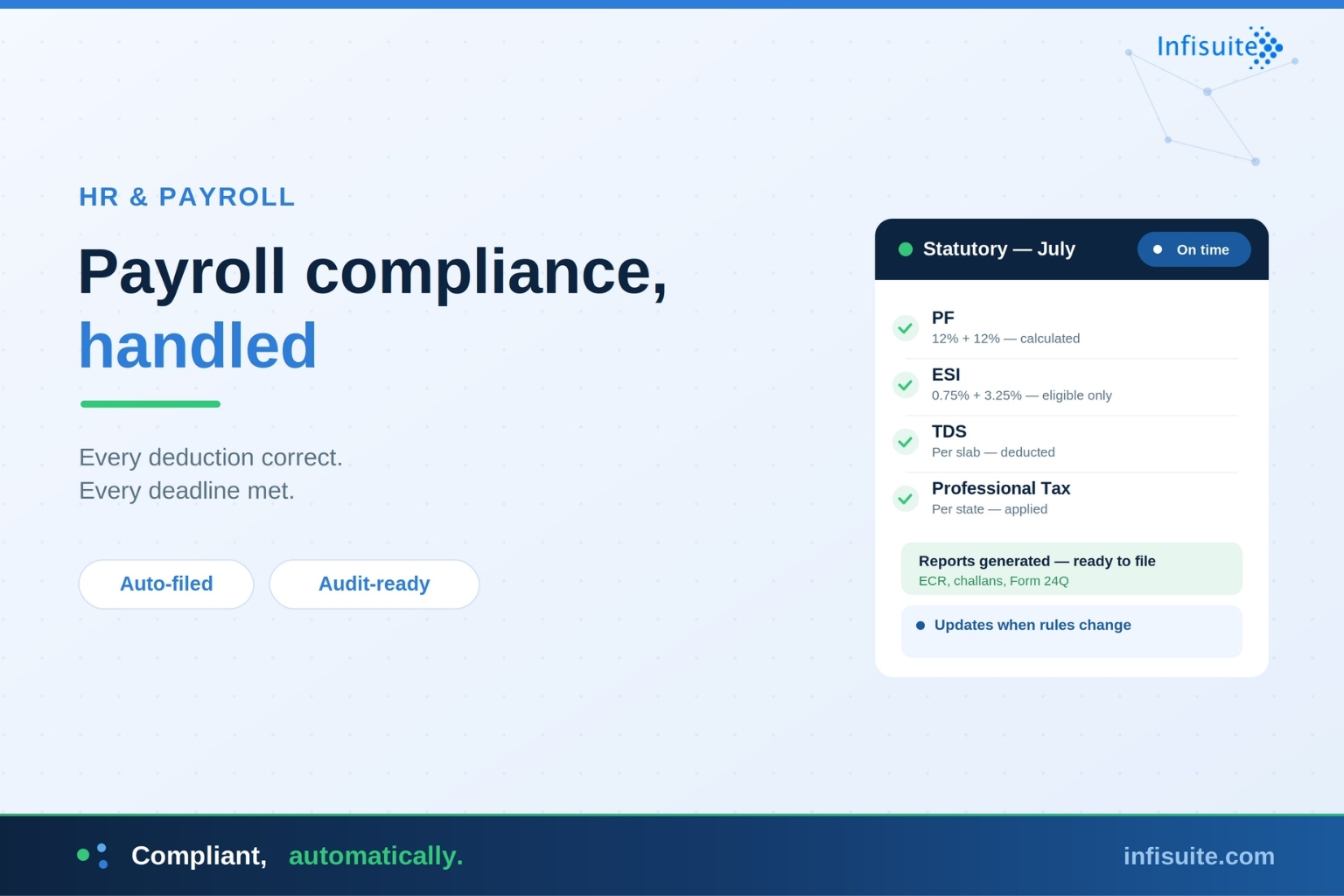
- It calculates every deduction correctly. PF, ESI, TDS, and PT are computed automatically for each employee.
- It applies the right thresholds. The system knows who is eligible for ESI, and who is not.
- It generates ready-to-file reports. ECR files, challans, and Form 24Q data come out in the right format.
- It updates when rules change. When the government revises a rate, the software updates too.
- It keeps an audit trail. Every calculation is recorded, so inspections are simple.
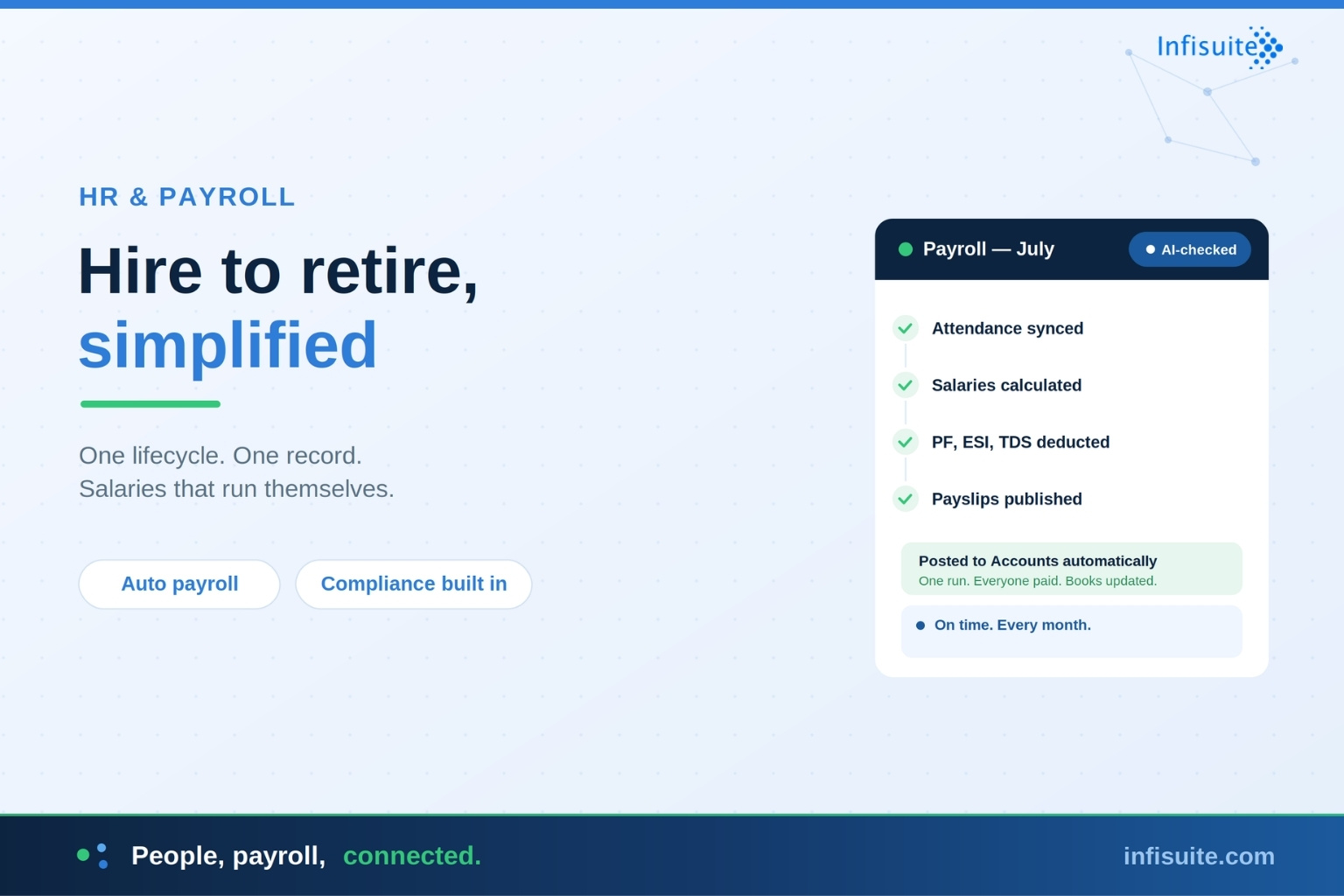
The biggest gain comes when payroll is connected to the rest of your business. When attendance and leave flow straight into payroll, the numbers are always right. And when payroll posts to your accounts automatically, the books stay accurate too. We explain this fully in our guide on how AI-driven HR & payroll software simplifies hire-to-retire.
This is exactly how Infisuite’s HR & Payroll module works. Statutory deductions are automatic. Reports are ready to file. And payroll connects to attendance, leave, and accounts on one platform.
Frequently Asked Questions
What is payroll compliance?
Payroll compliance means following all the laws that apply when you pay employees. In India, it mainly covers PF, ESI, TDS, and Professional Tax. For each, you must calculate, deduct, deposit, and file correctly and on time.
What are the main statutory deductions in Indian payroll?
The four main ones are PF (Provident Fund), ESI (Employees’ State Insurance), TDS (Tax Deducted at Source), and Professional Tax. PF and ESI are shared between employee and employer. TDS is income tax. Professional Tax is a state-level tax.
When does PF and ESI become mandatory?
PF applies to businesses with 20 or more employees. ESI applies to businesses with 10 or more, and covers staff earning up to ₹21,000 gross per month. Once you cross either threshold, coverage is mandatory.
What are the penalties for payroll non-compliance?
Penalties vary by rule. Late deposits attract interest, such as 1.5% per month on late TDS. Fines can range from ₹10,000 to ₹1 lakh per violation. Serious breaches can lead to legal action.
How can software help with payroll compliance?
Payroll software calculates every deduction automatically, applies the correct thresholds, and generates ready-to-file reports. It updates when rules change and keeps an audit trail. This removes most of the manual work and error risk.
Conclusion
Payroll compliance is not optional. It is a legal duty, and the cost of getting it wrong is high.
The rules are complex. They change often. And doing it by hand almost guarantees mistakes.
The simplest fix is to automate. Connected payroll software keeps every deduction correct and every deadline met. It turns compliance from a monthly worry into a background task, so you can focus on running your business.
Written by Anjana A
ERP & Business Software Specialist, Infisuite
Anjana A writes about ERP, HR operations, and business automation for growing SMEs. She focuses on clear, practical guidance that helps businesses stay compliant and run their people operations without stress.
Want payroll compliance handled automatically? Talk to the Infisuite team to see the HR & Payroll module in action.