

Quick Answer
AI-driven cloud HR & payroll software simplifies hire-to-retire by connecting every stage of the employee lifecycle — recruitment, onboarding, attendance, payroll, compliance, performance, and exit — into one automated workflow. Attendance and leave flow straight into salary calculations, statutory deductions compute themselves, payslips generate automatically, and payroll posts directly to your books. AI adds foresight on top: spotting attendance anomalies, payroll errors, and attrition signals before they become problems. The result is error-free, on-time salaries every month — without spreadsheets, re-entry, or compliance stress.
Key Takeaways
- Hire-to-retire is your third core business cycle — alongside purchase-to-pay (money out) and order-to-cash (money in), it manages your people.
- Payroll errors are lifecycle errors. Most salary mistakes trace back to disconnected attendance, leave, and HR records.
- Connected HR means payroll computes itself — attendance and leave flow into salaries automatically, with statutory deductions built in.
- AI adds foresight — anomaly detection in payroll, attendance pattern alerts, and early attrition signals.
- Cloud makes it work everywhere — multi-branch, multi-location teams on one system, with employee self-service on any device.
Every employee in your business travels the same journey: hired, onboarded, present every day, paid every month, developed over years, and — eventually — exited. HR teams call this journey hire-to-retire.
In most growing businesses, that journey runs on a patchwork: a spreadsheet for attendance, another for leave, payroll calculated manually at month-end, compliance documents in folders, and appraisal records in someone’s inbox. Every handoff between them is a chance for an error — and payroll errors are the ones employees never forget.
So how does AI-driven cloud HR & payroll software simplify hire-to-retire? By connecting every stage into one workflow, automating the calculations that cause the most pain, and adding AI foresight that catches problems before payday. This guide walks through the full lifecycle, stage by stage.
What Is Hire-to-Retire?
Hire-to-retire (also written H2R) is the complete employee lifecycle — every process from the moment you decide to hire someone until their final settlement when they leave. As Microsoft’s business process guidance describes it, hire-to-retire is one of the core end-to-end processes every organization runs, covering recruitment, onboarding, time and attendance, payroll, development, and separation.
If that “end-to-end cycle” framing sounds familiar, it should. We’ve covered your other two core cycles in this series: purchase-to-pay (money going out) and order-to-cash (money coming in). Hire-to-retire is the third — the cycle that manages your people. And like the other two, it breaks in exactly the same way: disconnected records, manual re-entry, and delays hiding in every handoff.
The Hire-to-Retire Lifecycle, Stage by Stage
1. Recruitment and Hiring
The lifecycle starts before day one. Connected HR software manages job requisitions, candidate pipelines, and offer letters in one place — so when a candidate accepts, their information flows straight into the employee record. No re-typing the same details into three systems.
2. Onboarding
New joiners get a structured start: documents collected digitally, policies acknowledged, assets assigned, and system access provisioned — all tracked against an onboarding checklist. The employee’s master record is complete from day one, which matters more than most businesses realise: payroll accuracy starts with clean employee data.
3. Attendance and Leave
Attendance is captured automatically — biometric, web, or mobile check-in for field teams — and leave requests route through approval workflows with balances updated in real time. This stage is the silent foundation of payroll: when attendance and leave live in the same system as salaries, month-end reconciliation disappears.
4. Payroll Processing
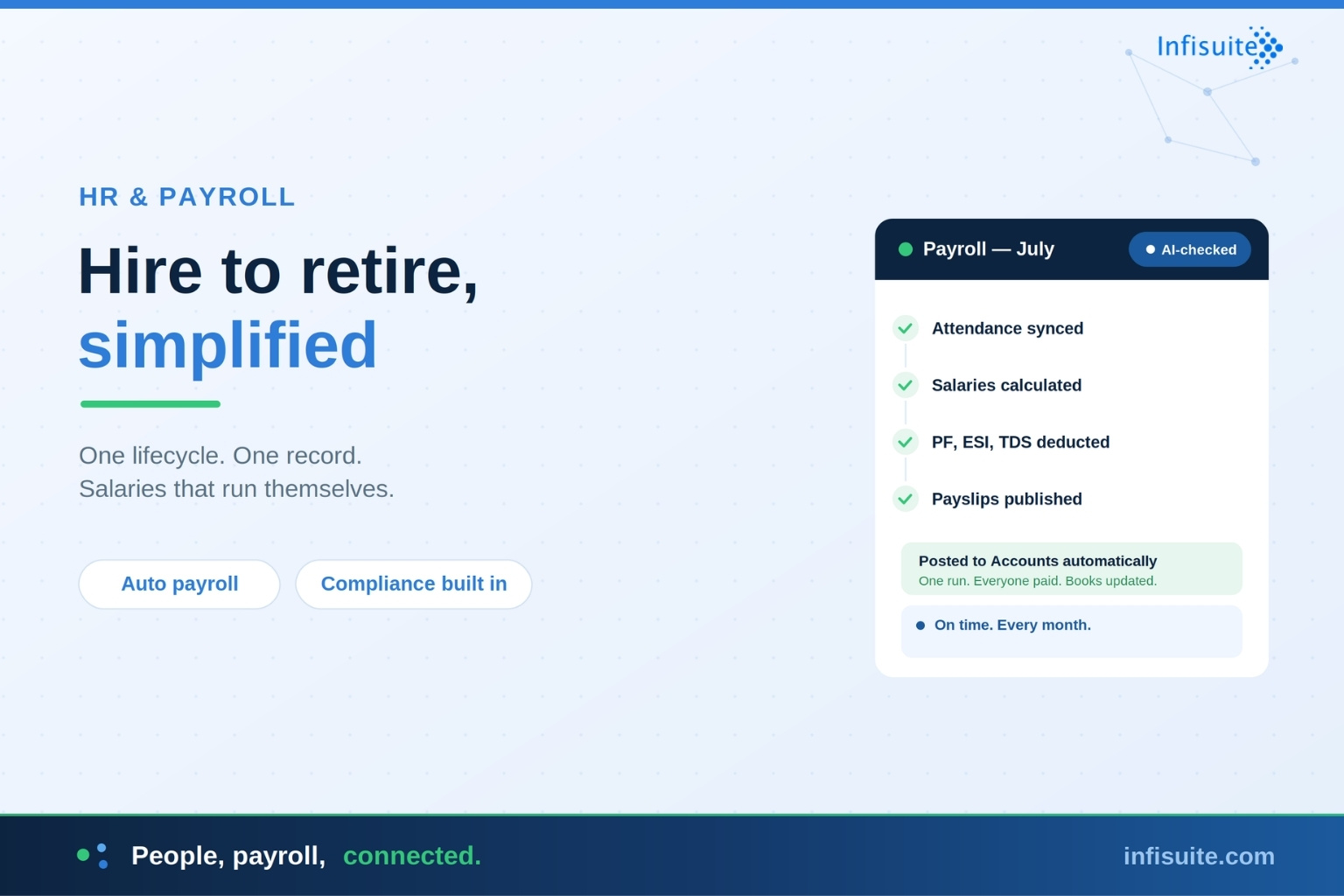
This is where connection pays off most visibly. Salaries calculate directly from attendance, leave, and salary-structure data — no spreadsheet exports, no manual day-counting. Statutory deductions compute automatically, payslips generate and publish to employee self-service, and salary payments reconcile against the payroll run. What used to take days of careful manual work becomes a review-and-approve step.
5. Statutory Compliance
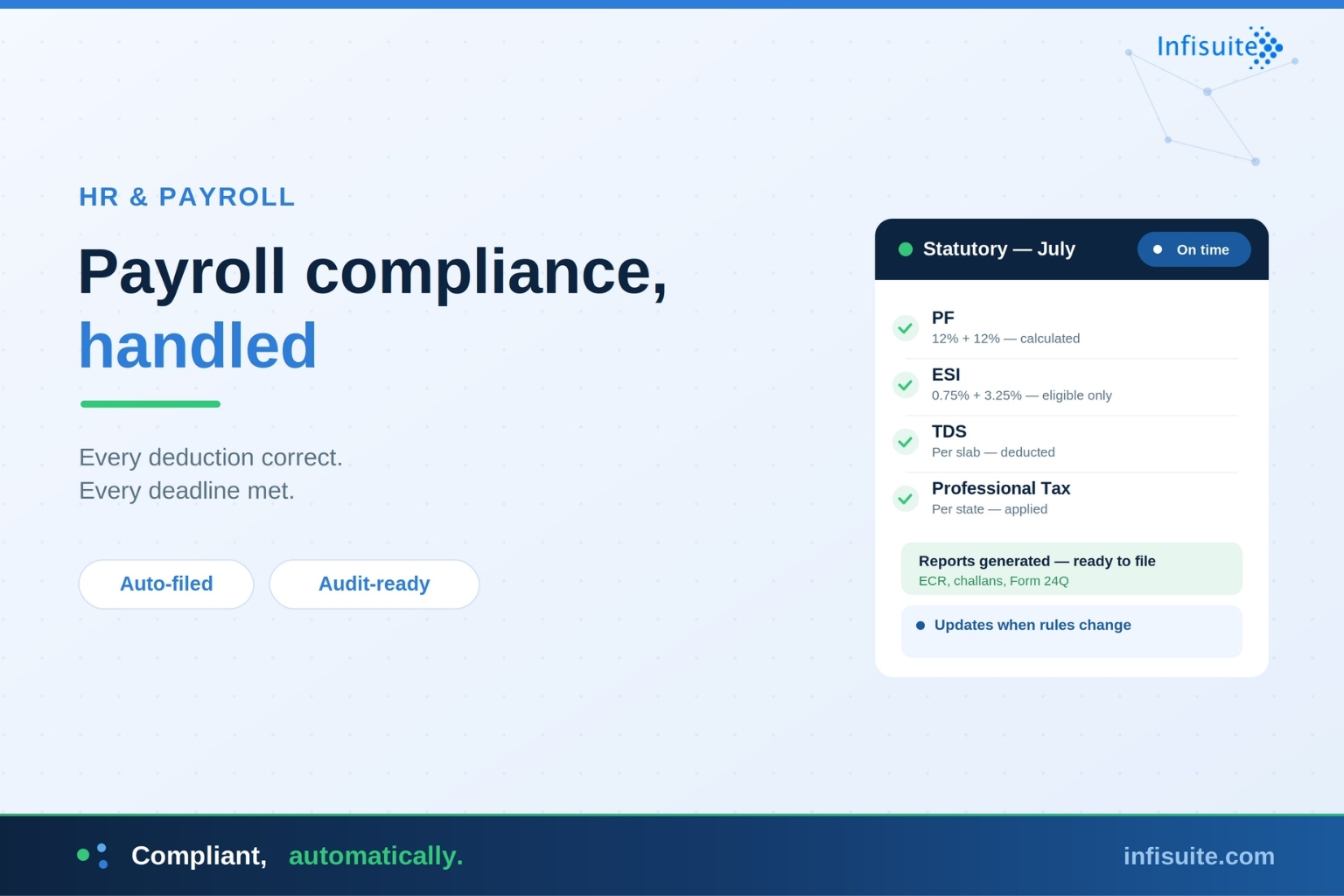
Compliance is where manual payroll carries the most risk. Connected payroll auto-calculates statutory deductions — in India, that means PF, ESI, TDS, and professional tax — and generates the reports required for regulatory submission. Every calculation leaves an audit trail, so inspections and audits become document-retrieval exercises rather than panics. For businesses operating across regions, rules are applied per location automatically.
6. Performance and Growth
Appraisals, goals, promotions, and transfers are tracked against the same employee record — so salary revisions flow into payroll without re-entry, and an employee’s full history lives in one place instead of scattered emails.
7. Exit and Final Settlement
When an employee leaves, the system runs the exit checklist — asset recovery, access revocation, notice-period tracking — and calculates the full and final settlement: pending salary, leave encashment, deductions, and dues. The lifecycle closes as cleanly as it opened.
Manual vs Connected Hire-to-Retire
| Stage | Manual / Disconnected | AI-Driven Cloud HR & Payroll |
|---|---|---|
| Employee records | Scattered across files and folders | One master record, complete history |
| Attendance & leave | Registers and spreadsheets, reconciled monthly | Captured live, balances always current |
| Salary calculation | Manual, days of effort, error-prone | Automatic from attendance + salary structure |
| Statutory compliance | Manual calculations, deadline stress | Auto-computed, reports generated, audit trail |
| Payslips & queries | Emailed on request, HR answers each query | Employee self-service, any device |
| Exit settlement | Weeks of back-and-forth | Checklist-driven, calculated automatically |
How AI Makes HR & Payroll Smarter
Automation removes the manual work. AI adds judgement on top of it. As McKinsey’s research on people and organizational performance consistently shows, organizations that apply data and technology to their people processes make faster, better workforce decisions.
In practice, AI-driven HR & payroll means:
- Payroll anomaly detection. Salary runs are scanned for out-of-pattern amounts — a duplicate reimbursement, an unusual overtime spike, a deduction that doesn’t match history — flagged before payment, not after.
- Attendance pattern alerts. Rising absenteeism, repeated late arrivals, or leave-balance anomalies surface automatically, so managers see the trend before it becomes a problem.
- Attrition signals. Patterns that historically precede resignations — leave spikes, performance dips, disengagement — get flagged early, giving managers a chance to act.
- Smarter workforce planning. Headcount costs, overtime trends, and department-wise analytics are available on demand — turning HR data into decisions, not just records.
Why Cloud — and Why Connected
Cloud matters for HR more than almost any other function, because HR serves everyone. Employees check payslips on their phones. Field teams mark attendance from site. Managers approve leave from anywhere. Multi-branch businesses run one payroll across locations with centralized control — something desktop-bound systems simply can’t do.
And connection completes the picture. Here’s the insight that ties this series together: payroll is a finance event, not just an HR event. Every salary run creates accounting entries — salaries payable, statutory liabilities, reimbursements. In a disconnected setup, someone re-enters all of it into the accounting system every month.
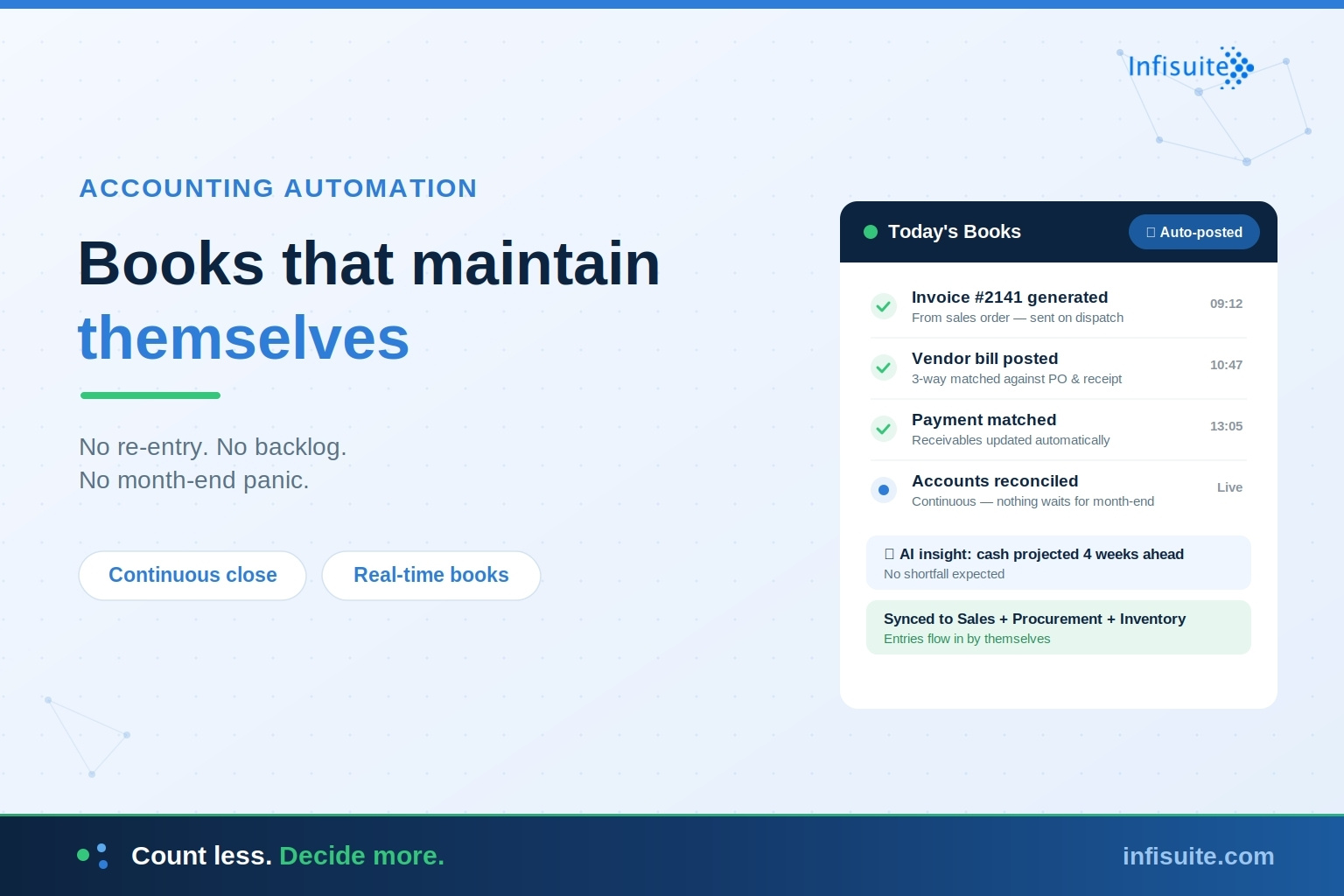
On a connected platform, payroll posts to the books automatically — the same way accounting automation handles your other transactions. One payroll run: employees paid, compliance calculated, books updated. Zero re-entry.
This is exactly how Infisuite’s HR & Payroll module works — attendance and leave auto-linked to payroll, statutory deductions computed with regulatory reports ready, multi-branch support with centralized control, employee self-service for payslips and tax documents, and payroll flowing straight into Accounts.
Who Needs HR & Payroll Software?
- Salary calculation takes days, and errors still slip through
- Attendance, leave, and payroll live in separate spreadsheets
- Statutory deadlines create monthly stress
- Employees email HR for payslips, balances, and tax documents
- You operate across branches or locations with separate registers
- Exit settlements drag on for weeks
If several of these sound familiar, your hire-to-retire cycle is running on manual effort that software was built to remove. For the broader readiness picture, see our guide on when businesses actually need an ERP system.
Frequently Asked Questions
What is hire-to-retire in HR?
Hire-to-retire (H2R) is the complete employee lifecycle — recruitment, onboarding, attendance and leave, payroll, compliance, performance management, and exit with final settlement. HR & payroll software connects all these stages into one workflow on a single employee record.
How does connected payroll reduce salary errors?
Most payroll errors come from re-entry — attendance in one system, leave in another, salaries calculated in a spreadsheet. When attendance and leave auto-link to payroll, salaries calculate from live data with no manual transfer, removing the most common error sources.
Does HR & payroll software handle statutory compliance like PF, ESI, and TDS?
Yes. Modern payroll systems auto-calculate statutory deductions and generate the reports required for regulatory submission, with a full audit trail. Rules are applied per region, which matters for multi-location businesses.
What does AI actually do in HR software?
AI scans payroll runs for anomalies before payment, flags unusual attendance patterns, surfaces early attrition signals, and turns workforce data into on-demand analytics — adding foresight on top of automation.
Should HR & payroll be standalone or part of an ERP?
Part of an ERP for most growing businesses. Payroll creates accounting entries every month — salaries, statutory liabilities, reimbursements. When HR shares a platform with Accounts, payroll posts to the books automatically; standalone HR tools leave that re-entry to your finance team.
Conclusion
Your business runs on three cycles: money out, money in, and people. The first two we’ve covered — and the third, hire-to-retire, breaks the same way: disconnected records, manual re-entry, and errors that surface at the worst possible moment, which for HR means payday.
AI-driven cloud HR & payroll software fixes the cycle structurally. One employee record from hiring to exit. Attendance flowing into salaries automatically. Compliance computing itself with an audit trail. Payroll posting straight to the books. And AI watching the patterns humans miss.
Accurate salaries, on time, every month — with HR free to work on people instead of paperwork. That’s hire-to-retire, simplified.
Written by Anjana A
ERP & Business Software Specialist, Infisuite
Anjana A writes about ERP, HR operations, and business automation for growing SMEs. Drawing on Infisuite’s experience helping businesses connect their employee lifecycle to payroll and finance, she focuses on practical guidance for error-free, stress-free people operations.
Ready for payroll that runs itself? Talk to the Infisuite team to see the HR & Payroll module in action.