

Quick Answer
Businesses struggle with too many software tools because each tool solves one problem in isolation — but together, they create a bigger one. Disconnected tools don’t share data automatically, so information fragments across systems, teams work from conflicting numbers, and employees waste hours manually transferring data between platforms. Costs multiply too: overlapping subscriptions, repeated training, and integration workarounds. The fix isn’t another tool. It’s consolidation — moving to connected systems, like an integrated ERP, where departments share one platform and one source of truth.
Key Takeaways
- Each tool solves one problem — together they create a bigger one. Tool sprawl grows quietly, one subscription at a time.
- Disconnected tools fragment your data. Teams end up working from different numbers and conflicting reports.
- The hidden costs are bigger than the subscriptions — manual data transfer, app-switching, training, and reconciliation time.
- More dashboards won’t fix it. Analytics on disconnected data just visualises the inconsistency.
- The goal isn’t more software — it’s connected software. Consolidation into an integrated platform restores clarity.
Today most businesses depend on software to run their operations. Companies use different tools for sales, finance, project management, and reporting. Technology helps teams work faster and improve productivity.
However, as organizations grow, they often keep adding new tools. Over time this creates complexity instead of clarity.
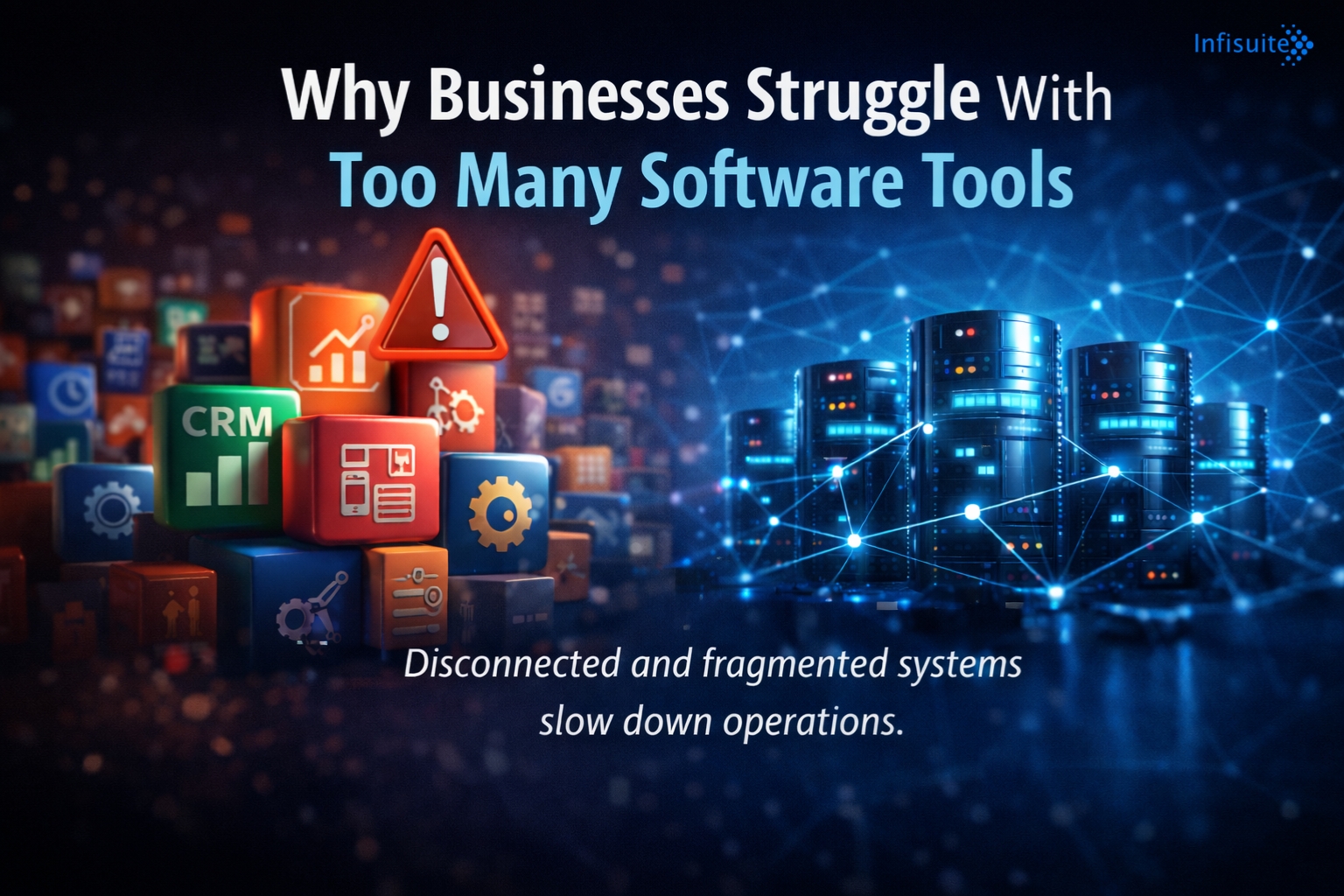
When different systems operate separately, data becomes fragmented. Teams start working with different numbers and reports. Instead of improving efficiency, too many software tools can actually slow organizations down.
According to McKinsey’s research on data-driven organizations, companies that successfully integrate their systems and data perform better than those using disconnected technology platforms.
How Tool Sprawl Happens
No business plans to end up with dozens of disconnected tools. It happens gradually — and each individual decision makes sense at the time.
The sales team adopts a CRM to track leads. Finance subscribes to accounting software. Operations picks a project management tool. HR adds a workforce platform. Marketing brings in its own analytics.
Each tool solves a real problem for one team. But nobody is watching the whole picture. And as businesses continue adding more software, managing these systems becomes more difficult.
This challenge is closely related to the issue discussed in our article on why data everywhere still fails to deliver business clarity. Many organizations eventually reach a point where different departments rely on entirely different systems — and none of them talk to each other.
The Real Problem: Tools That Don’t Share Data
The problem isn’t the number of tools by itself. It’s that these tools rarely share data automatically.
As a result, teams start working with different datasets and conflicting reports. Sales reports one revenue figure. Finance reports another. Nobody is sure which is right.
This situation is explained in more detail in our article on why fragmented systems slow decision-making.
Using too many disconnected tools creates several problems inside a business:
- Scattered information. Data gets stored across multiple systems, making it difficult to see a complete picture of business performance.
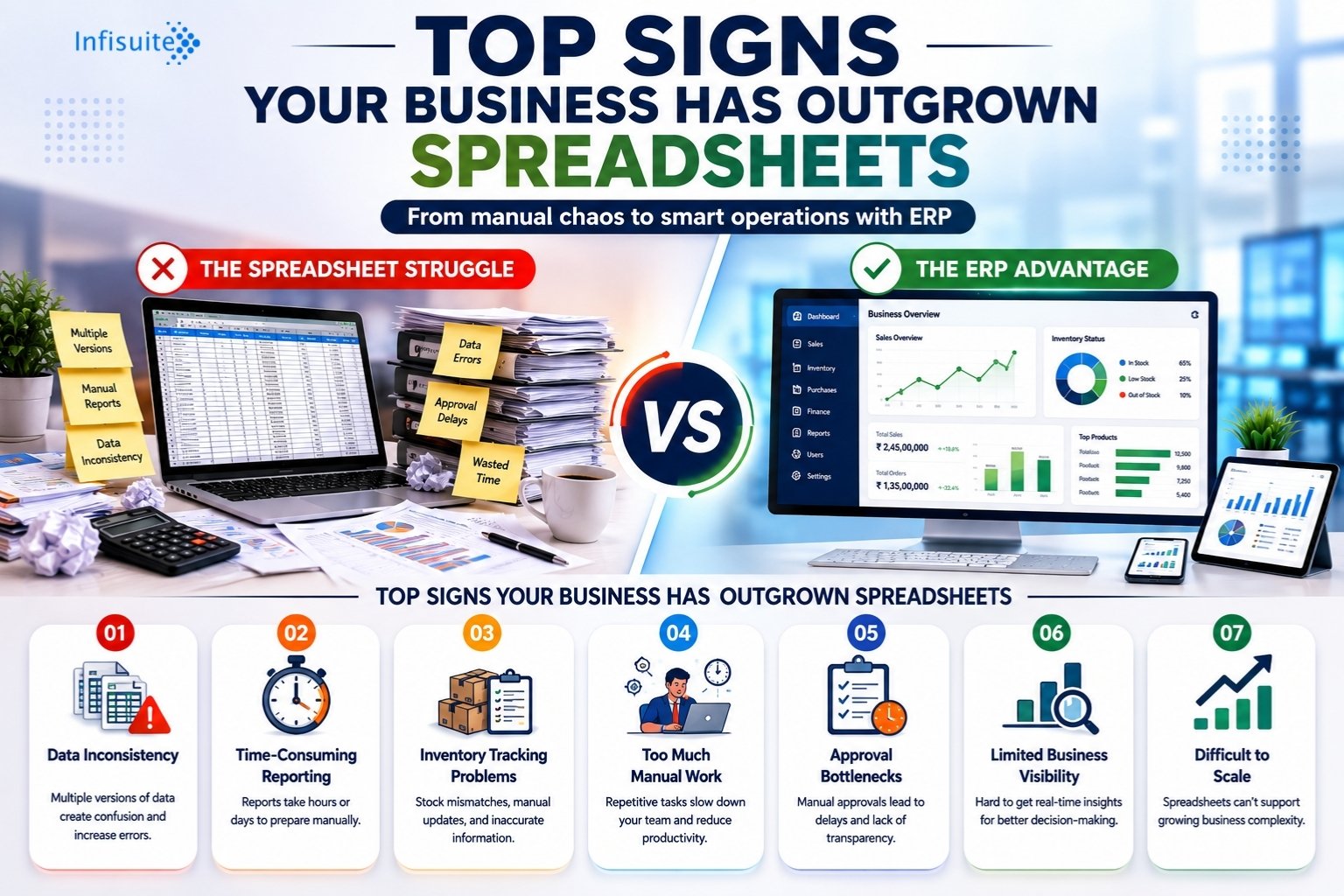
- Manual work. Employees export data from different tools and combine it by hand in spreadsheets — slow, repetitive, and error-prone.
- Conflicting reports. Each tool calculates metrics its own way, so numbers rarely match across systems.
- Rising costs. Overlapping subscriptions, repeated training, and integration workarounds add up quietly.
- Constant app-switching. Teams lose focus jumping between platforms all day instead of working in one place.
Many Tools vs One Connected Platform
| Dimension | Many Disconnected Tools | One Connected Platform |
|---|---|---|
| Data | Fragmented across systems | Unified in one database |
| Reports | Conflicting numbers, manual compiling | Consistent, real-time |
| Daily work | Constant app-switching, re-entry | One login, one workflow |
| Costs | Many overlapping subscriptions | One predictable platform cost |
| Visibility | No complete business picture | Full view in one place |
Why Adding More Tools Makes It Worse
When businesses feel the pain of fragmentation, the instinct is often to add another tool — a dashboard, an integration platform, a reporting layer.
But if the underlying systems remain disconnected, new tools simply visualize inconsistent data. The root problem — fragmentation — stays untouched.
The bigger issue is that many of these tools are not connected. Organizations need systems that share data across departments and provide a unified view of operations.
This is why many companies aim to build a Single Source of Truth, where business data is aligned across systems. Connected systems reduce fragmentation and help teams collaborate using the same information.
According to Gartner’s data integration guidance, strong data integration improves operational efficiency and business intelligence.
The Fix: Simplify and Connect
To reduce complexity, businesses should focus on simplifying their technology ecosystem. That means fewer, better-connected systems — not more tools stacked on top.
Practical steps include:
- Audit your current tools. List every tool, its cost, and its purpose. Identify overlaps and rarely-used subscriptions.
- Identify your core operations. Sales, finance, inventory, procurement, HR — these need to share data, not live in separate tools.
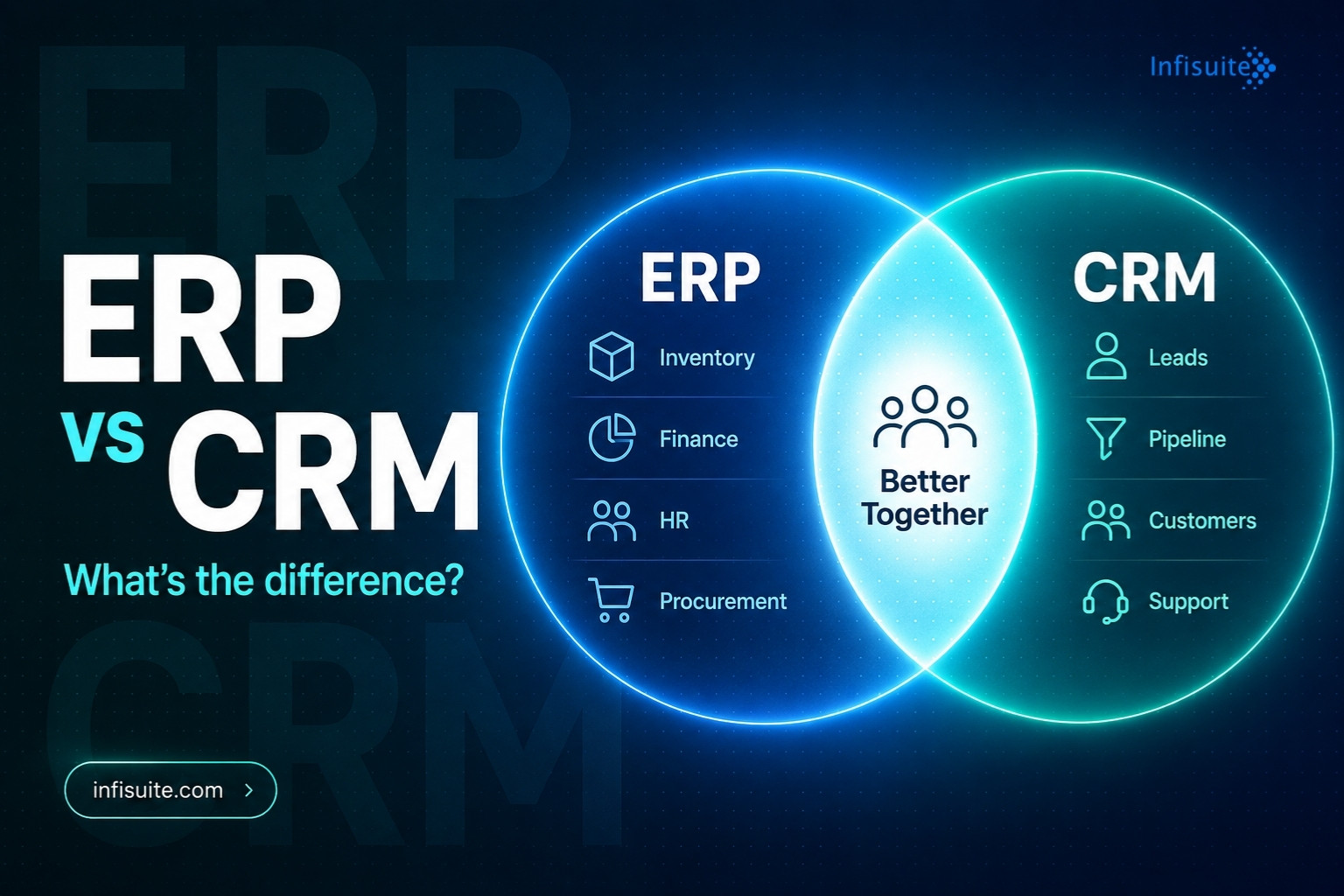
- Consolidate onto a connected platform. An integrated ERP replaces multiple disconnected tools with modules that share one database.
- Phase the transition. Move one process at a time — starting where fragmentation hurts most.
This also helps organizations avoid the operational challenges described in our article on how data silos destroy operational efficiency.
When systems are connected, teams gain better visibility into business operations. Instead of spending time managing software, organizations can focus on growing their business. That’s exactly what Infisuite is built for — replacing a scattered stack of tools with one integrated platform covering inventory, accounts, procurement, sales, CRM, and more.
Frequently Asked Questions
Why do businesses end up with too many software tools?
Tool sprawl happens gradually. Each department adopts tools that solve its own problems — a CRM for sales, accounting software for finance, project tools for operations. Each decision makes sense in isolation, but collectively they create a fragmented, disconnected stack.
What problems do too many tools cause?
Fragmented data, conflicting reports, manual data transfer between systems, constant app-switching, rising subscription costs, and no complete view of business performance. Instead of improving efficiency, disconnected tools slow organizations down.
Is the number of tools the real problem?
Not exactly. The core problem is that the tools don’t share data automatically. Even a modest number of disconnected tools creates fragmentation, while well-connected systems can support complex operations cleanly.
Will adding a dashboard or integration tool fix it?
Usually not. If the underlying systems remain disconnected, dashboards simply visualise inconsistent data. The root fix is consolidation — moving core operations onto systems that share one database.
How does an ERP solve tool sprawl?
An integrated ERP replaces multiple disconnected tools with connected modules — inventory, accounts, procurement, sales, CRM — that share one real-time database. Data flows automatically between departments, reports always agree, and the business gets one complete view of operations.
Conclusion
Software plays an important role in modern business. But using too many disconnected tools can create operational challenges. When systems operate separately, data becomes fragmented, collaboration becomes difficult, and decision-making slows down.
Organizations that simplify their systems and connect their data gain a clearer view of their operations.
The goal is not to use more software — it is to use connected systems that help businesses make better decisions.
There’s no magic number — the problem isn’t the count, it’s the connection. A business running five tools that share data cleanly is in better shape than one running three that don’t. Ask a simpler question instead: how much time does your team spend moving data between systems, and how often do your reports disagree?
If the answer is “too much” and “too often,” you’ve reached your limit — whatever the number.
Written by Anjana A
ERP & Business Software Specialist, Infisuite
Anjana A writes about ERP, data, and business automation for growing SMEs. Drawing on Infisuite’s experience helping businesses consolidate scattered tools, she focuses on practical guidance for building simpler, connected operations.
Ready to replace tool sprawl with one connected platform? Talk to the Infisuite team to see how an integrated ERP simplifies your operations.