

Quick Answer
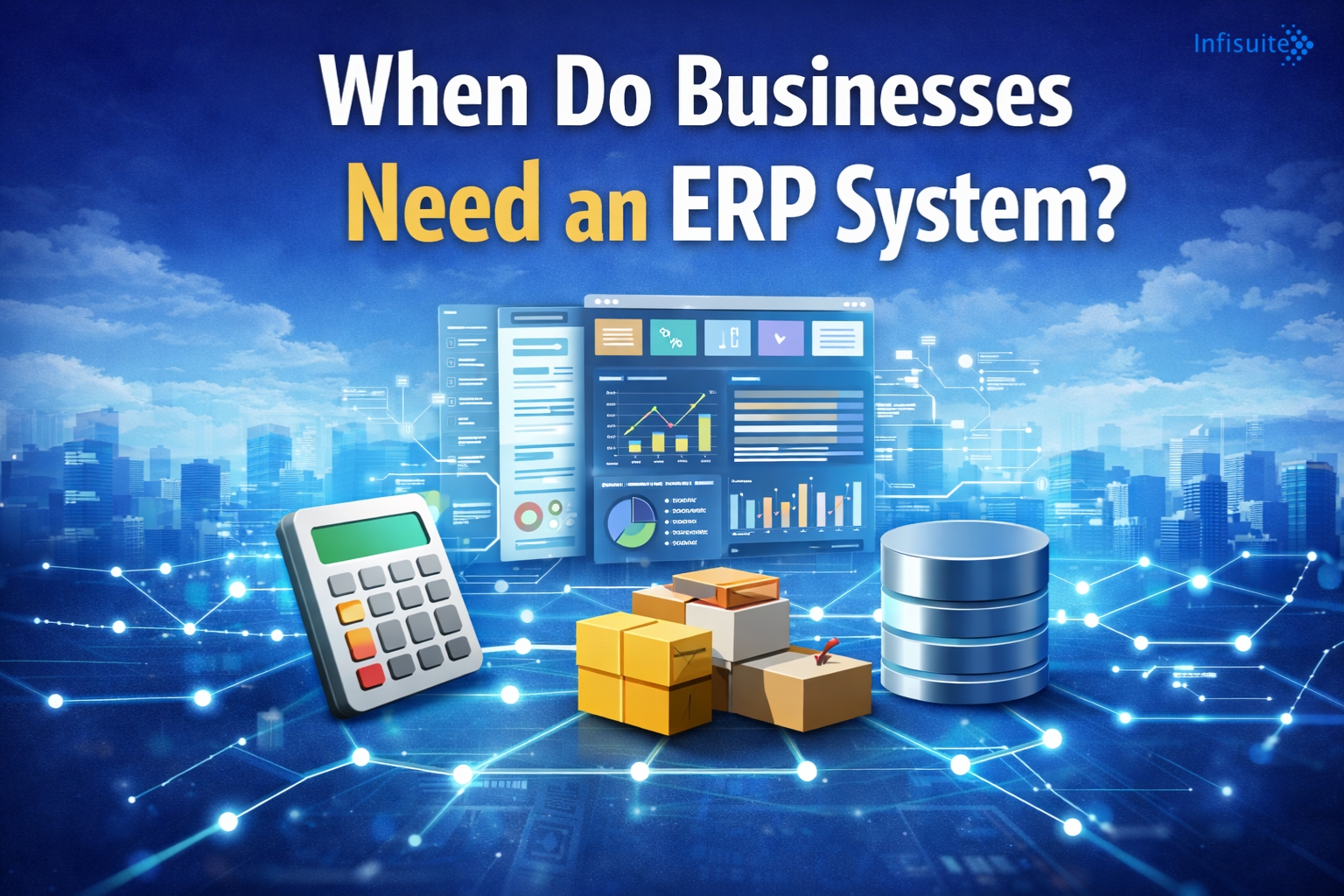
Businesses need an ERP system when operational complexity outpaces their current systems — not at any particular size or revenue. The seven strategic signals: opening a second location, adding a new sales channel, management waiting hours or days for basic answers, preparing for investment or audit, growing supply chain complexity, scaling headcount by 30%+ in a year, and rising compliance requirements. If two or more of these describe your business, it’s time. The businesses that struggle are those that wait until problems become a crisis and implement under pressure.
Key Takeaways
- ERP readiness is about complexity, not size. A 15-person business can need ERP more than a 100-person one.
- Seven strategic signals indicate readiness — expansion, new channels, slow answers, funding prep, supply chain complexity, rapid hiring, and compliance.
- Implement before expansion, not after. The best time is before your second location or channel — not amid the chaos.
- Waiting has a compounding cost — operational debt, messier data, and a harder eventual implementation.
- Two or more “urgent” signals = act now. Planned implementations beat emergency ones every time.
There is no universal answer to when a business needs ERP. A 20-person trading company might desperately need it. A 200-person professional services firm might manage fine without it. The right time to implement ERP depends not on company size alone — but on the specific combination of growth stage, operational complexity, and strategic ambition that defines your business at any given moment.
What is clear from research by Gartner is that businesses which delay ERP adoption past the point of operational necessity pay a compounding cost — in inefficiency, in missed opportunities, and in the expense of emergency implementation under pressure rather than planned implementation with time to do it right.
This guide focuses on the strategic business signals — growth milestones, expansion triggers, and organizational thresholds — that indicate a business is ready for ERP, regardless of what industry it operates in or how many employees it has.
The Wrong Way to Think About ERP Timing
Most businesses ask the wrong question. They ask: “Are we big enough for ERP?”
The right question is: “Is our operational complexity outpacing our systems?”
ERP readiness is not about headcount or revenue thresholds. It’s about whether the systems and processes you currently use can still support the decisions, the coordination, and the visibility your business needs to grow. A business with 15 people managing complex multi-location inventory across three product lines may need ERP far more urgently than a 100-person business running a simple, repetitive service model.
The signals described below are strategic and operational — they represent the moments when the cost of not having ERP begins to exceed the cost of implementing it.
Strategic Signal 1: You Are Opening a Second Location or Market
The moment a business expands beyond a single location — a second office, a new warehouse, a new geographic market — the coordination complexity of the business increases exponentially, not linearly. Suddenly, inventory needs to be tracked across multiple sites. Sales data needs to be consolidated from different locations. HR and payroll need to manage teams in different places. Finance needs a consolidated view across entities.
Spreadsheets and disconnected systems cannot support this coordination reliably. Multi-location businesses that don’t implement ERP before expanding typically find themselves managing the chaos manually — which consumes management time, creates errors, and slows decision-making at exactly the moment when speed matters most.
ERP trigger: Before opening your second location, not after.
Strategic Signal 2: You Are Entering a New Sales Channel
Adding a new sales channel — launching an eCommerce store, onboarding a distributor, signing a large retail client, or entering an export market — dramatically increases the volume and complexity of order processing, inventory management, and financial reconciliation.
Each new channel brings its own data formats, pricing rules, fulfillment requirements, and reporting needs. Without a central ERP system to unify this data, businesses end up with fragmented visibility: one system for direct sales, another for the distributor channel, a spreadsheet for exports. Reconciling these into a coherent business picture becomes a full-time job — and the errors that result from manual reconciliation become increasingly costly.
ERP trigger: When adding a second or third sales channel with meaningfully different operational requirements.
Strategic Signal 3: Your Management Team Can No Longer Get Answers Quickly
One of the clearest strategic signals that a business needs ERP is when the management team regularly has to wait — hours or days — for answers to basic operational questions. How much stock do we have of Product X? What is our gross margin this month? How many open purchase orders do we have? Which customers haven’t paid in 60 days?
In a well-run ERP environment, these questions are answered in seconds from a dashboard. In a spreadsheet-dependent business, answering them requires someone to manually compile data from multiple sources — which takes time, introduces errors, and means decisions are made on information that is already out of date by the time it arrives.
When management spends more time chasing data than acting on it, the business is ready for ERP. As McKinsey research on digital transformation shows, businesses with real-time operational visibility consistently outperform those relying on delayed, manually compiled reporting.
ERP trigger: When the management team routinely waits more than a few hours for operational data they need to make decisions.
Strategic Signal 4: You Are Preparing for Investment, Acquisition, or Audit
Investors, acquirers, and auditors all need the same thing: clean, reliable, verifiable financial and operational data. Businesses that cannot produce this quickly — because their data lives across disconnected spreadsheets and systems — create immediate red flags in due diligence processes.
A business preparing for a funding round, an acquisition conversation, or a regulatory audit needs to be able to demonstrate that its financial records are accurate, its operational processes are controlled, and its data is auditable. ERP provides the audit trail, the financial integrity, and the reporting capability that these processes require.
Trying to implement ERP in response to an investor request or audit requirement is a high-pressure, high-risk scenario. Implementing it proactively — before these conversations happen — is far more effective.
ERP trigger: 12–18 months before a planned funding round, acquisition, or major audit.
Strategic Signal 5: Your Supply Chain Is Becoming Complex
As businesses grow, their supply chains typically become more complex — more suppliers, longer lead times, more SKUs, more warehousing locations, more quality control requirements. Managing this complexity manually or through disconnected systems creates compounding risk: a supplier delay that isn’t flagged in time, a stock-out that wasn’t predicted, a quality issue that slips through because inspection records aren’t centralized.
ERP provides end-to-end supply chain visibility — from purchase order to goods receipt to quality check to stock movement to sales order fulfillment. For businesses whose supply chain complexity has grown beyond what spreadsheets can reliably track, this visibility is not a luxury — it is an operational necessity.
ERP trigger: When supply chain errors, stock-outs, or supplier issues are regularly creating operational disruptions or customer complaints.
Strategic Signal 6: You Are Scaling Your Team Significantly
Adding headcount — especially across multiple departments simultaneously — creates coordination and process challenges that manual systems cannot handle reliably. Onboarding new employees into spreadsheet-dependent workflows means training them on workarounds rather than systems. It means giving them access to files rather than controlled, role-based access to a centralized platform. It means their work immediately contributes to the data fragmentation problem rather than solving it.
ERP provides a structured operational environment that scales with headcount. New team members are onboarded into defined workflows, with appropriate access levels, contributing to centralized data from day one. This is how growing businesses maintain operational control as they scale — rather than losing it.
ERP trigger: When planning to grow headcount by 30% or more within a 12-month period, especially across multiple departments.
Strategic Signal 7: Compliance and Regulatory Requirements Are Increasing
Businesses operating in regulated industries — financial services, healthcare, food and beverage, manufacturing, export — face increasing compliance requirements as they grow. Demonstrating compliance requires audit trails, controlled processes, accurate record-keeping, and the ability to produce verifiable documentation quickly.
ERP systems provide the controlled environment, audit trails, and documentation capabilities that compliance requires. Businesses trying to manage compliance through spreadsheets and manual records are running significant risk — both of regulatory failure and of the operational disruption that a compliance investigation creates.
ERP trigger: When regulatory requirements are increasing and current systems cannot reliably produce the documentation and audit trails needed.
ERP Readiness Assessment: Where Does Your Business Stand?
| Strategic Signal | 🟢 Not Yet | 🟡 Approaching | 🔴 Urgent |
|---|---|---|---|
| Multi-location expansion | Single location, stable | Planning second location | Already multi-location, no ERP |
| New sales channels | Single channel, simple | Evaluating new channels | Multiple channels, manual reconciliation |
| Management data visibility | Reports available same day | Reports take 1–2 days | Reports take 3+ days, frequent errors |
| Investment/audit readiness | No plans in near term | Exploring funding options | Active investor or audit conversations |
| Supply chain complexity | Simple, few suppliers | Growing supplier base | Regular stock-outs or supplier issues |
| Headcount growth | Stable team size | Moderate hiring planned | Rapid multi-department hiring underway |
| Compliance requirements | Minimal, stable | Requirements increasing | Audit trail gaps already identified |
If you answered “Urgent” to two or more of the signals above, your business needs ERP now. If you answered “Approaching” to three or more, you should begin evaluating ERP options within the next 6 months.
What Happens When Businesses Wait Too Long
The cost of delaying ERP adoption is not always visible — but it is real and it compounds over time. Businesses that wait too long typically experience:
- An accumulation of operational debt — manual workarounds, data inconsistencies, and process inefficiencies that become harder to unwind with each passing month
- A more expensive and disruptive implementation when they eventually do adopt ERP — because the data is messier, the processes are more entrenched, and the team is more resistant to change
- Missed growth opportunities that required operational capabilities the business didn’t have
- Increased risk of significant errors — in inventory, in finance, in compliance — as manual systems operate beyond their reliable capacity
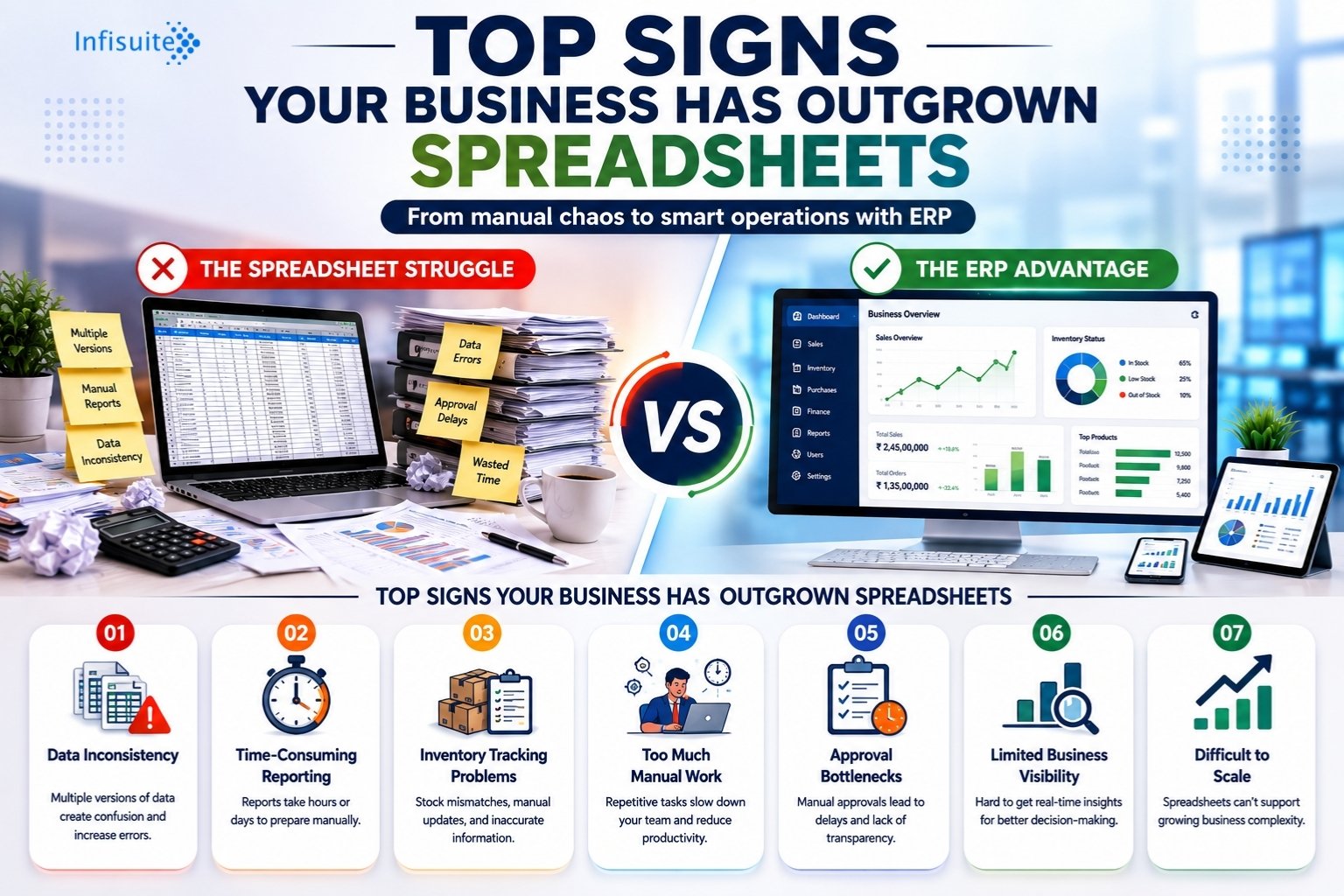
For a practical look at the day-to-day operational signs that indicate your systems are already struggling, read our guide on the top signs your business has outgrown spreadsheets. For guidance on how to approach ERP implementation without complexity or large upfront costs, see our guide on how SMEs can start ERP without complexity.
Frequently Asked Questions
Is there a revenue or headcount threshold that triggers ERP need?
No universal threshold exists. Operational complexity, not size, is the primary driver. A 15-person business with complex multi-location inventory may need ERP more urgently than a 100-person business with simple, repetitive operations.
Can we implement ERP gradually, or does it have to be all at once?
A phased implementation is strongly recommended — especially for SMEs. Start with the 2–3 modules that address your most critical operational problems, stabilize those, then expand. This reduces risk, cost, and disruption significantly.
How far in advance should we start planning ERP implementation?
Ideally, begin evaluating ERP options 6–12 months before you anticipate needing it — not after the operational problems have become a crisis. Rushed implementations carry significantly higher failure risk.
What’s the difference between needing ERP and needing better software tools?
Individual software tools solve isolated problems. ERP solves the coordination problem — it connects your departments, centralizes your data, and gives you a single operational platform. If your challenge is fragmented data and disconnected processes across departments, you need ERP, not more point solutions.
How do we know which ERP is right for our business?
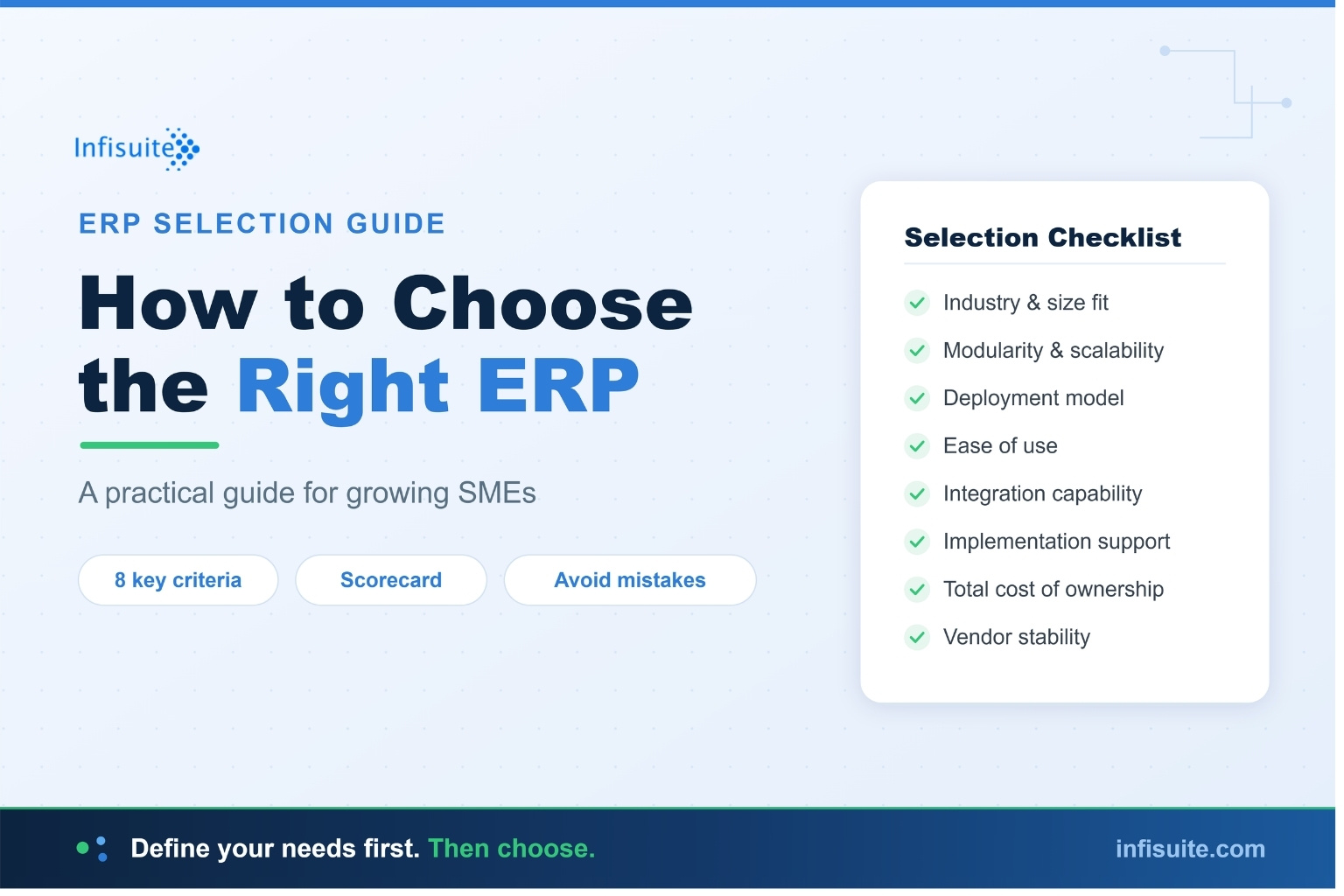
Start with a comparison of deployment models. Read our guide on Cloud ERP vs Traditional ERP to understand the key differences, then evaluate platforms based on industry fit, implementation support, and total cost of ownership.
Conclusion
The right time to implement ERP is before your operational complexity exceeds your systems’ ability to manage it — not after. The strategic signals described in this guide are the business milestones and growth triggers that consistently indicate ERP readiness, regardless of company size or industry.
Businesses that act on these signals proactively — with planned, phased implementations — consistently achieve better outcomes than those that implement reactively, under pressure, after the operational problems have already become critical.
If two or more of the signals in this guide describe your business today, the right time to start evaluating ERP is now.
At Infisuite, we help businesses assess their ERP readiness, choose the right platform, and implement with confidence — at every stage of growth. Learn more at infisuite.com.
Written by Anjana A
ERP & Business Software Specialist, Infisuite
Anjana A writes about ERP, business software, and automation for growing SMEs. Drawing on Infisuite’s experience helping businesses time and plan ERP adoption, she focuses on practical guidance for scaling operations at the right moment, in the right way.