


Quick Answer
The 50% wage rule comes from the Code on Wages, 2019. It says that allowances excluded from the definition of wages cannot be more than half of an employee's total remuneration. If they are, the excess is added back and treated as wages. Because PF, gratuity and other statutory amounts are calculated on wages, this raises those costs for most employers. The four labour codes came into force on 21 November 2025, with enforcement rolling out from April 2026. The Ministry of Labour has since issued FAQs and a compliance handbook. State rules still vary.
Key Takeaways
- Wages now have one definition. Basic pay, dearness allowance and retaining allowance. That is it.
- The rule is about exclusions, not basic pay. Excluded allowances cannot cross 50% of total remuneration. The excess gets added back to wages.
- Most Indian salary structures fail this test. Basic pay of 30% to 40% with large allowances was normal. It no longer works.
- PF and gratuity costs go up. Both are calculated on wages. A bigger wage base means bigger contributions.
- Take-home pay may fall slightly. More goes into PF. Retirement savings rise instead.
- Exit settlements now have a 48-hour deadline. Full and final settlement must be completed within two days of an employee leaving.
- State rules still vary. Labour is a concurrent subject. Check the position for the states you operate in before restructuring.
Most Indian companies built salary structures the same way for years.
Keep basic pay low. Put the rest into allowances. HRA, conveyance, special allowance, and whatever else fit. It was legal, and it kept PF and gratuity costs down.
That approach no longer works.
On 21 November 2025 the four labour codes came into force. They replace 29 older laws, and were notified by the Ministry of Labour and Employment. The one that matters most for payroll is the Code on Wages, 2019, because it changes what the word "wages" means.
What Changed in the Definition of Wages
Before the codes, different laws defined wages differently. PF used one definition. Gratuity used another. Bonus used a third.
Now there is one definition across all four codes.
Wages are basic pay, dearness allowance, and retaining allowance.
Everything else sits outside. The Code lists the exclusions, and they cover the components most salary slips are built from:
- House rent allowance
- Conveyance allowance
- Overtime
- Bonus payable under any law
- Commission
- Employer contribution to provident fund or pension
- Value of house accommodation, and of light, water and medical benefits
- Travelling allowance or the value of travel concession
- Sums paid to defray special expenses
- Gratuity payable on termination
- Retrenchment compensation and other termination benefits
Two clarifications from the Ministry of Labour are worth noting, because they affect how the test runs in practice.
Overtime allowance is counted within the 50% computation. Employers in sectors with heavy overtime should check their structures carefully, because overtime can push exclusions past the line without anyone planning it.
Annual performance-linked incentives do not form part of wages for statutory calculation.
This is where the 50% rule comes in.
The 50% Wage Rule, Explained Properly
The rule is often described as "basic pay must be 50% of CTC." That is not quite what the Code says, and the difference matters.
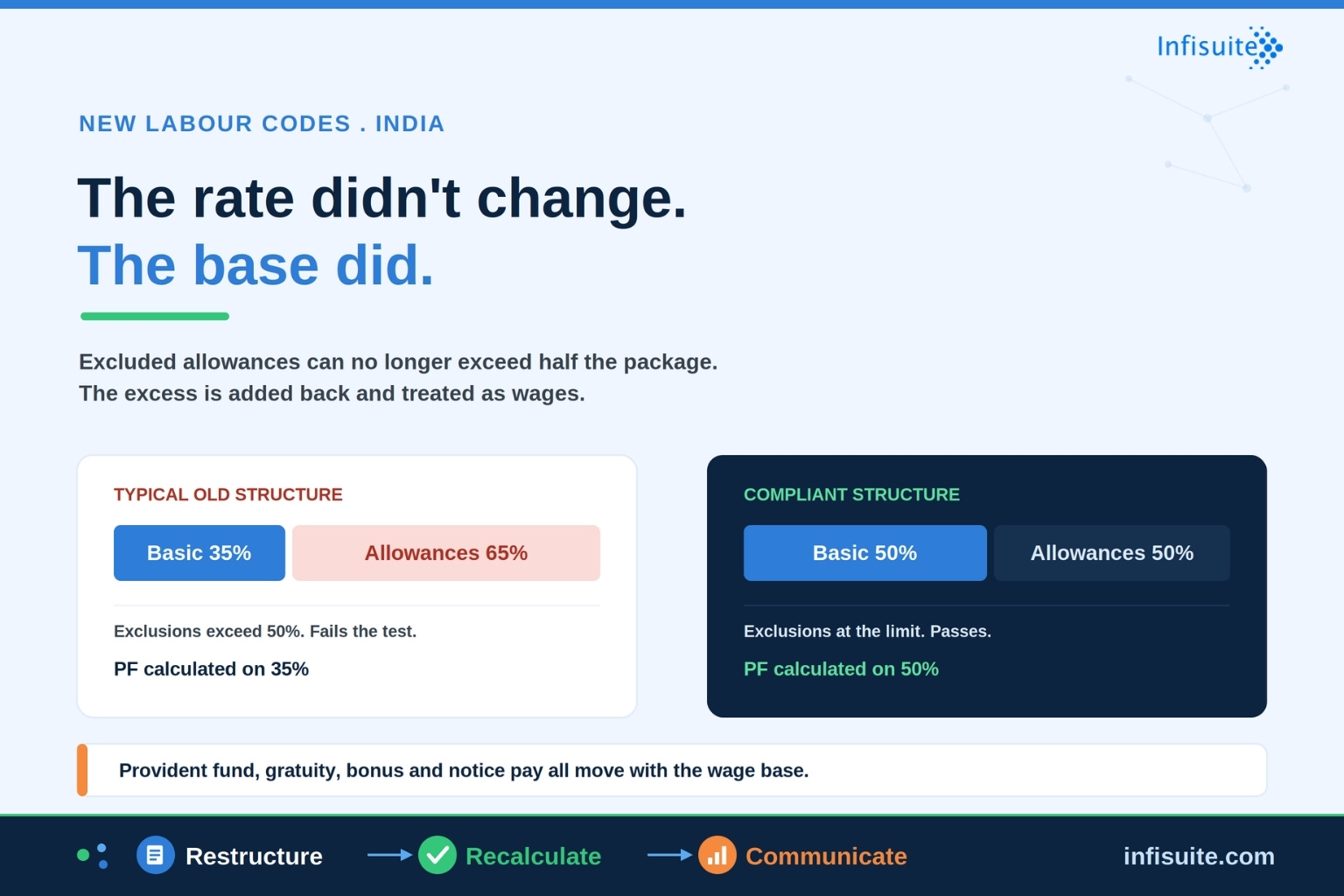
What it actually says is this. Add up all the excluded components. If that total is more than half of the employee's total remuneration, the excess is added back and counted as wages.
So the test runs on the exclusions, not on basic pay.
In practice the outcome is similar. If your allowances exceed half the package, wages rise to meet the line. Most employers get there by raising basic pay, because that is simpler than reworking every allowance.
But the distinction is worth understanding. You are not required to set basic pay at exactly 50%. You are required to keep exclusions at or below 50%.
A worked example
Take an employee on ₹10,00,000 per year.
| Component | Old structure | Compliant structure |
|---|---|---|
| Basic pay | ₹3,50,000 (35%) | ₹5,00,000 (50%) |
| Allowances | ₹6,50,000 (65%) | ₹5,00,000 (50%) |
| Wage base for PF | ₹3,50,000 | ₹5,00,000 |
In the old structure, exclusions are 65% of the package. That fails the test. The excess of 15% gets added back to wages anyway.
So the employer has a choice. Restructure deliberately, or have the calculation done for them.
What This Costs
Several statutory amounts are calculated on wages. When the wage base rises, they all rise with it.
Provident fund. Employee and employer each contribute 12% of wages. A larger wage base means a larger contribution from both sides. The rates themselves are unchanged — payroll compliance in India covers the current PF, ESI and TDS rates and deadlines.
Contribution rules and filing requirements are administered by the Employees' Provident Fund Organisation.
Gratuity. Calculated on last drawn wages. Higher wages mean a higher payout, and a higher liability on the books today.
Employees' State Insurance. Contributions are calculated on gross wages, and coverage thresholds are set by the Employees' State Insurance Corporation.
Bonus. Eligibility and calculation both reference wages.
Leave encashment and notice pay. Both are usually computed on basic or on wages, so both move.
For the employee, take-home pay often dips slightly. More of the salary goes into provident fund. That money is not lost, but it is not available this month either.
The longer-term effect is the opposite. Retirement savings grow, and so does the eventual gratuity payout.
What Else Changed
The wage definition gets most of the attention, but it is not the only change that affects payroll.
Exit settlement must be completed within 48 hours. When an employee leaves, by resignation or termination, full and final settlement is now due within two days. The old norm was thirty to forty-five days.
This is the change most likely to break an existing payroll process. A full and final settlement pulls together final attendance, leave encashment, notice pay, gratuity, recovery of advances and assets, and the TDS treatment on all of it. Doing that inside two days is difficult if the inputs sit in different places. It is the exit end of the hire-to-retire payroll cycle, and the point where most manual processes fail.
Fixed-term employees earn gratuity after one year. The old threshold was five years of continuous service. This change applies to fixed-term staff. Permanent employees still need five years. Fixed-term staff are also entitled to the same benefits as permanent employees doing comparable work.
There is a transitional point here worth raising with your advisor. For employees who were in service before 21 November 2025, gratuity computation may need to be split across the old and new wage bases.
A four-day week is now permitted. The OSH Code allows twelve-hour days across four days, as an alternative to shorter days across five. Total weekly hours stay capped at forty-eight. It is an option, not a requirement, and work beyond the prescribed hours is paid at double rate.
Appointment letters are required. Every employee should receive one setting out the terms of employment.
Minimum wage coverage widened. It now applies to all employees rather than only those in scheduled employment.
Social security coverage extends further. The Code on Social Security brings gig and platform workers into scope for the first time. Contribution rates for aggregators are subject to separate notification.
Where the Rules Currently Stand
The codes came into force on 21 November 2025. Enforcement began rolling out from April 2026.
The full text of the Code on Wages, 2019 is available on the India Code portal. The Ministry of Labour has published FAQs and a compliance handbook for employers. Those clarified several points, including how employer provident fund contributions are treated in the 50% test, and the treatment of overtime and performance bonuses.
The remaining variable is state rules. Labour is a concurrent subject, so each state notifies its own. Some have done so, others are still working through it, and the practical compliance date can differ depending on where you operate.
What this means. The wage definition is settled and will not change. If your state has notified its rules, compliance is already mandatory. If it has not, the direction is still clear enough to plan against.
What to Do Now
Run the test across your payroll. For every employee, add up the excluded components and compare against total remuneration. You are looking for anyone whose exclusions exceed 50%. In most Indian companies that will be almost everyone.
Model the cost before you decide. Work out what the new wage base does to provident fund, gratuity liability and bonus. The number is usually larger than expected, because gratuity liability moves for every employee at once.
Decide how to absorb it. Either the employer takes the increase, or the package is restructured so that cost to company stays flat. The second option reduces take-home pay, so it needs explaining.
Explain it to employees. A salary slip that changes shape without warning creates more problems than the restructure itself. People see a lower net figure and assume something is wrong.
Update the payroll system. Wage definitions, contribution formulas and salary templates all need to reflect the new basis. This is the step that gets forgotten, and it is the one that causes wrong deductions from the first run.
Rework the exit process. Forty-eight hours is not enough time to assemble a settlement from four systems. Work out what your current process actually takes, and where the delay sits.
Why This Is Harder on Spreadsheets
The calculation itself is not difficult. Doing it for every employee, every month, while state rules are still settling, is. This is the point at which most companies find they have outgrown spreadsheets for payroll.
A restructure touches attendance, leave, reimbursements and statutory deductions at the same time. If those live in separate files, every change has to be carried across by hand.
The 48-hour settlement rule makes this sharper. A full and final calculation needs final attendance, leave balance, gratuity, notice pay and TDS, all agreeing with each other, within two working days. That is achievable when the data sits in one place. It is not when someone has to request figures from three departments first.
The same problem shows up in ordinary payroll compliance, where PF, ESI, TDS and professional tax each have their own rate and deadline. The labour codes add a further layer, because the base those calculations run on has changed.
When payroll runs on a connected system, the wage definition is set once. Deductions calculate against it automatically, and the payroll cost posts to the books without re-entry. That is what the Infisuite HR & Payroll module is built to do.
Frequently Asked Questions
What is the 50% wage rule?
It comes from the Code on Wages, 2019. Allowances excluded from the definition of wages cannot exceed half of an employee's total remuneration. If they do, the excess is added back and treated as wages for statutory calculations.
Does basic pay have to be exactly 50% of CTC?
No. The test applies to the excluded components, not to basic pay. If exclusions stay at or below 50%, the structure is compliant. Raising basic pay is simply the most common way employers get there.
When did the labour codes come into force?
The four codes came into force on 21 November 2025. Central and state rules are still being notified, so the detailed compliance position continues to develop.
Which components count as wages?
Basic pay, dearness allowance and retaining allowance. Everything else, including HRA, conveyance, overtime, bonus, commission and employer provident fund contributions, sits outside the definition.
Will my take-home pay go down?
It may fall slightly. A larger wage base means a larger provident fund deduction. The money goes into retirement savings rather than disappearing, but it is not available in that month's salary.
Do PF and gratuity costs increase for employers?
Yes, where the current structure has exclusions above 50%. Both are calculated on wages, so a higher wage base raises both the monthly contribution and the gratuity liability carried on the books.
What changed for fixed-term employees?
Gratuity applies after one year of service rather than five. This applies to fixed-term employees; permanent employees still need five years of continuous service. Fixed-term staff are also entitled to the same benefits as permanent employees doing comparable work.
What is the 48-hour settlement rule?
When an employee leaves, full and final settlement must be completed within two days. Previously most companies took thirty to forty-five days. The change affects how exit processes are run more than what is paid.
Does overtime count towards the 50% calculation?
Yes. The Ministry of Labour clarified that overtime allowance is included in the computation. Employers with significant overtime should review their structures, because it can push exclusions past the threshold unintentionally.
Are annual performance bonuses treated as wages?
No. The Ministry has confirmed that annual performance-linked incentives do not form part of wages for statutory calculation.
Do we have to restructure salaries immediately?
The wage definition already applies. But state rules are still being notified, and the practical position varies. Model the impact now, and confirm the current requirement for your states before making changes.
Conclusion
The 50% wage rule is a change of base, not a change of rate. Contribution percentages stay where they were. What moves is the figure they are applied to.
For most Indian employers that means higher provident fund costs, a higher gratuity liability, and a salary structure that needs rebuilding.
The companies that handle this well will do two things. Model the cost before restructuring, and explain the change to employees before the first payslip lands.
Written by Anjana A
ERP & Business Software Specialist, Infisuite
Anjana A writes about ERP, HR operations, and business automation for growing SMEs. She focuses on clear, practical guidance that helps businesses stay compliant and run their people operations without stress.
This article is general information, not legal or tax advice. State rules under the labour codes vary and continue to be notified. Confirm the current position with your advisor before restructuring salaries.
Need your payroll to reflect the new wage definition automatically? Talk to the Infisuite team.