

Quick Answer
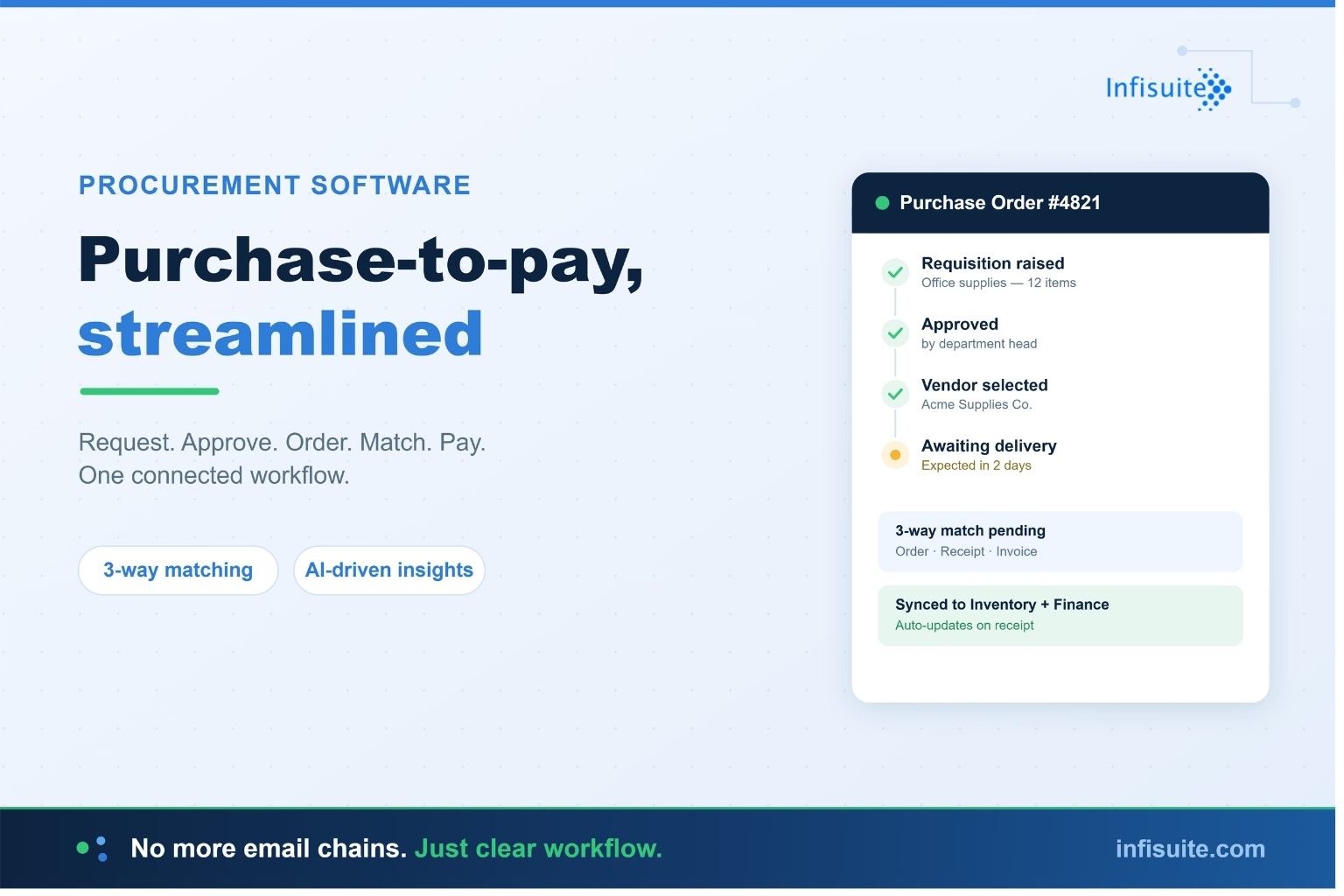
Procurement software streamlines purchase-to-pay by connecting every step — raising requests, approving them, selecting vendors, issuing purchase orders, receiving goods, and matching invoices — into one automated workflow. It replaces email chains and spreadsheets, so requests never get lost, approvals never stall, and invoices are matched before payment. For growing businesses, the biggest win is visibility: knowing exactly what’s been requested, approved, ordered, and paid for. The most effective procurement software is built into a wider ERP platform, so purchasing connects automatically to inventory and finance.
Key Takeaways
- Procurement software manages purchase-to-pay: request, approve, order, receive, and pay — in one workflow.
- It replaces email and spreadsheet chaos with clear approval trails and vendor records.
- Vendor management is core. Onboarding, evaluation, and performance tracking build a reliable supplier base.
- Integration is where the real value is. Connected to inventory and finance, purchases update stock and books automatically.
- Standalone procurement tools create new silos — the same problem standalone inventory tools cause.
Every business buys things — raw materials, supplies, services, equipment. As a business grows, so does the volume and complexity of that buying. What worked as an email to a supplier stops working once you have multiple departments, multiple vendors, and multiple approval steps.
So how does procurement software streamline all of this? By connecting every step of the purchase-to-pay cycle — request, approval, ordering, receiving, and payment — into one traceable workflow. This guide walks through exactly how that works, step by step, and why the right procurement setup can save real money — not just time.
What Is Procurement Software?
Procurement software manages the full cycle of buying goods and services for a business — from the first request to the final payment. This is often called the “purchase-to-pay” or “procure-to-pay” cycle.
Instead of requests scattered across emails, chats, and paper forms, procurement software gives you one system that tracks:
- What’s being requested — and by whom
- Who has approved it — and when
- Which vendor it’s going to — and on what terms
- What’s been received — and whether it matches the order
- What’s been paid — and whether it matches the invoice
The result is a fully traceable purchasing process, instead of a trail of emails nobody can easily follow.
The Purchase-to-Pay Cycle, Step by Step
1. Requisition (Indenting)
An employee or department raises a request for goods or services they need — known as an indent or requisition. This captures what’s needed, how much, and why.
2. Approval
The request routes automatically to the right approver, based on rules like department, value, or category. No more chasing someone down over email to sign off.
3. Vendor Selection
Once approved, the request is matched to a vendor — ideally chosen from a evaluated, trusted supplier base rather than whoever answers the phone first.
4. Purchase Order
A formal purchase order is issued to the vendor, capturing the agreed items, quantities, price, and terms. This becomes the official record both sides work from.
5. Goods Receipt
When the order arrives, it’s checked against the purchase order. Quantities and quality are verified before it’s accepted into stock.
6. Invoice Matching and Payment
The vendor’s invoice is matched against the purchase order and goods receipt — known as three-way matching — before payment is approved. This is the step that catches billing errors and prevents overpayment.
What Is 3-Way Matching in Procurement?
Three-way matching is the control step that protects your money. Before an invoice is paid, the system checks three documents against each other:
- The purchase order — what you agreed to buy, and at what price
- The goods receipt — what actually arrived, and in what condition
- The invoice — what the vendor is asking you to pay
If all three agree, payment is approved. If they don’t — the invoice charges more than the PO, or bills for more than was delivered — the mismatch is flagged before any money leaves your account.
Done manually, this checking is slow and often skipped under time pressure. Procurement software does it automatically on every invoice. That’s how billing errors, duplicate invoices, and overpayments get caught — consistently, not just when someone has time to check.
How AI Makes Procurement Smarter
Modern procurement software doesn’t just digitise the workflow — AI actively improves it. In an AI-driven platform, procurement gets smarter over time:
- Smarter purchase decisions. AI analyses purchase history and consumption patterns to suggest what to order, and when — before shortages happen.
- Vendor intelligence. Performance data across deliveries builds an objective picture of which vendors deliver on time, on spec, and on price.
- Anomaly detection. Unusual invoice amounts, duplicate billing, or off-contract pricing get flagged automatically for review.
- Spend insights. AI-driven analytics reveal where money is going by category, department, and vendor — surfacing savings opportunities humans miss.
This is the same intelligence we described in our guide to AI inventory management — applied to purchasing. And because Infisuite’s AI works across connected modules, procurement insights draw on real inventory and finance data, not isolated purchasing records.
Why Manual Procurement Breaks Down as You Grow
Early on, procurement by email works fine. A small team, a handful of vendors, low volume — informal processes are manageable.
But as a business grows, manual procurement creates real problems:
- Lost requests. Emails get buried. Requests get forgotten or duplicated.
- No approval trail. Nobody can say for certain who approved what, or when.
- Maverick spending. Without a system, people buy from whoever’s convenient — not the best-value, approved vendor.
- Invoice mismatches. Without matching invoices to orders and receipts, billing errors and overpayments slip through.
- No spend visibility. Leadership can’t see total spend by vendor, department, or category until it’s too late to act.
The stakes are real. Research by McKinsey on procurement excellence found that top-quartile procurement functions generate roughly twice the annual savings of bottom-quartile ones — and that modern cloud-based tools are making these capabilities accessible to businesses of all sizes, not just large enterprises. Poor purchasing visibility, meanwhile, drives unnecessary cost — duplicated orders, missed volume discounts, and invoice errors that go uncaught. These are the classic symptoms of process fragmentation we cover in our article on why fragmented systems slow decision-making.
Vendor Management: The Often-Overlooked Piece
Good procurement isn’t just about processing orders. It’s about building a reliable base of vendors you trust.
Strong vendor management includes:
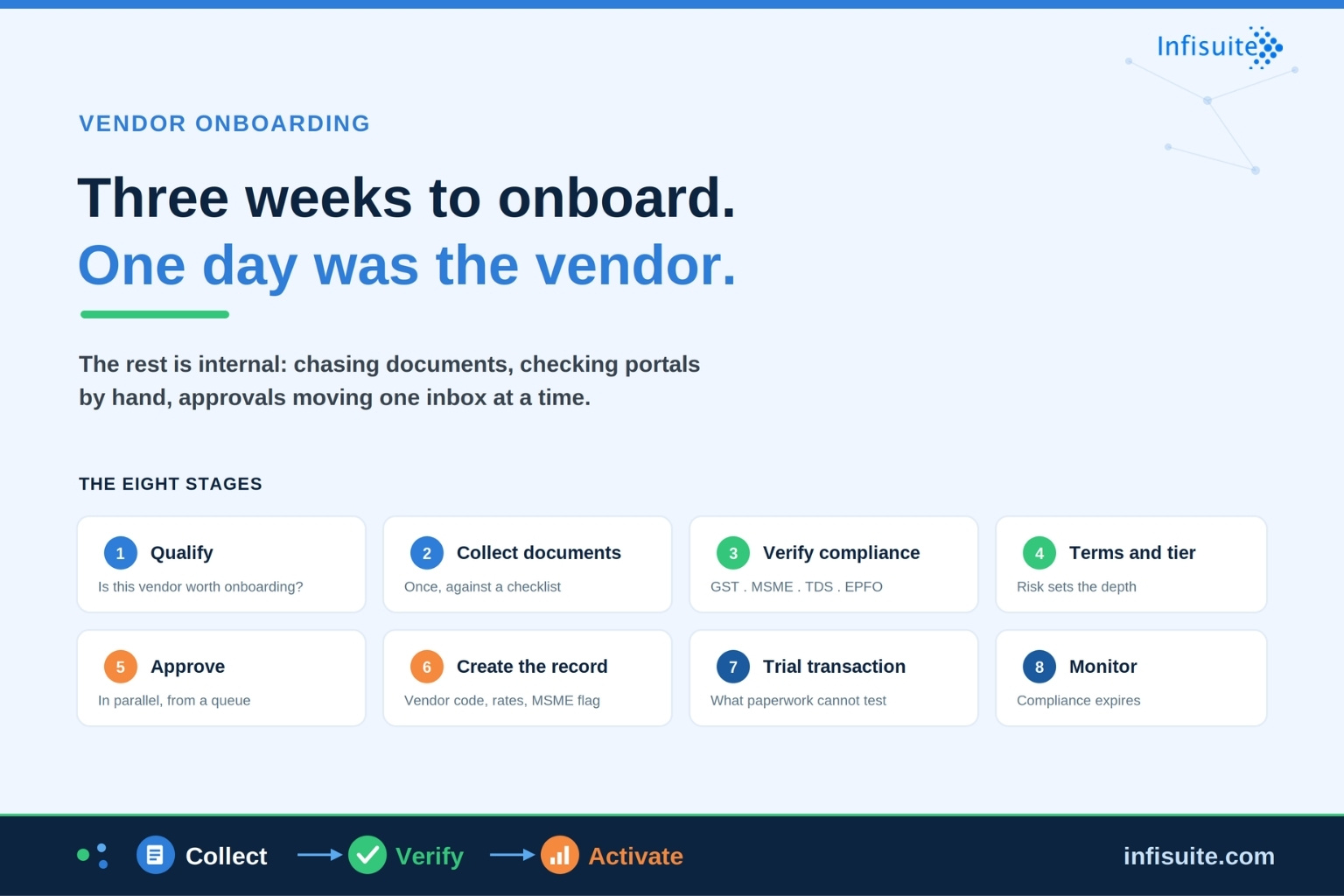
- Structured onboarding. Collecting the right documents and information upfront.
- Performance evaluation. Rating vendors on delivery speed, quality, and reliability after each order.
- Centralised records. One place to see every vendor’s history, documents, and performance.
- Risk management. The ability to flag or restrict underperforming or non-compliant vendors.
Over time, this turns procurement from reactive buying into a genuine competitive advantage — better pricing, more reliable delivery, and fewer surprises. McKinsey’s research on procurement-led transformation found that when procurement hits its savings targets, the company is nearly twice as likely to achieve its business-wide savings goals — evidence of how central good purchasing is to overall performance.
Why Standalone Procurement Tools Fall Short
Some businesses adopt a standalone procurement or purchasing tool — and hit the same wall we describe in our guide to AI inventory management software: it solves one problem while creating a new island of data.
A standalone procurement tool doesn’t know what’s in your inventory. It doesn’t know your cash position in finance. Every purchase has to be manually re-entered elsewhere — creating exactly the kind of data silo we explore in how data silos destroy operational efficiency.
The Better Approach: Procurement Connected to Inventory and Finance
The most effective procurement setup isn’t a standalone tool. It’s a procurement module built into a wider ERP platform, sharing data with inventory and finance.
In a connected platform, the flow is seamless:
- A purchase order is raised in procurement → expected stock appears in inventory
- Goods are received → inventory updates automatically
- The invoice is matched and approved → finance reflects the transaction instantly
No manual re-entry. No mismatched numbers. Just one connected purchase-to-pay flow.
Infisuite’s Procurement module is built exactly this way — managing the full lifecycle from indenting to vendor selection, with native integration to Inventory and Accounts for a truly connected operational flow.
Who Needs Procurement Software?
Procurement software delivers value to any business that buys regularly, but it becomes essential when:
- You’re managing purchasing across more than one department
- Approval delays are slowing down operations
- You can’t get a clear view of total spend by vendor or category
- Invoice mismatches or overpayments are becoming a problem
- You’re growing, and email-based purchasing can no longer keep up
If several of these sound familiar, it’s worth reading our guide on when businesses actually need an ERP system.
Frequently Asked Questions
What is procurement software?
Procurement software manages the full purchase-to-pay cycle — requisition, approval, vendor selection, purchase orders, goods receipt, and invoice matching — in one connected workflow, replacing email chains and spreadsheets.
What is the purchase-to-pay cycle?
Purchase-to-pay is the full process of buying: raising a request, getting it approved, selecting a vendor, issuing a purchase order, receiving the goods, and matching the invoice before payment.
Why does procurement need vendor management?
Because good procurement is about more than processing orders — it’s about building a reliable supplier base. Structured onboarding, performance evaluation, and centralised vendor records lead to better pricing and more reliable delivery over time.
Should procurement software be standalone or part of an ERP?
For most growing businesses, procurement built into an ERP platform is far more valuable than a standalone tool. When procurement shares data with inventory and finance, purchases update stock and accounts automatically, eliminating manual re-entry and data silos.
What’s the difference between purchase-to-pay and source-to-pay?
Purchase-to-pay (P2P) starts once you know what you need — covering requisition through payment. Source-to-pay (S2P) starts earlier, including strategic sourcing activities like identifying suppliers, running tenders, and negotiating contracts. For most growing businesses, purchase-to-pay is the core process to systematise first.
How does procurement software save money?
It improves spend visibility, prevents maverick and duplicate purchasing, and catches invoice mismatches through three-way matching between orders, receipts, and invoices — directly reducing overpayment and unnecessary cost.
Conclusion
Procurement software turns purchasing from a scattered, email-driven process into a clear, traceable workflow — from the first request to the final payment. It brings visibility to spend, accountability to approvals, and reliability to vendor relationships.
But the biggest gains come from connection. A standalone procurement tool solves one problem while creating a new silo. Procurement built into a connected platform — sharing data with inventory and finance — delivers the accuracy and efficiency that manual or standalone systems simply can’t.
For growing businesses ready to bring control to their purchasing, integrated procurement is the foundation worth building on.
Written by Anjana A
ERP & Business Software Specialist, Infisuite
Anjana A writes about ERP, procurement, and business automation for growing SMEs. Drawing on Infisuite’s experience helping businesses streamline purchasing, she focuses on practical guidance for building efficient, connected operations.
Ready to bring visibility and control to your purchasing process? Talk to the Infisuite team to see how a connected procurement module fits your business.