

Quick Answer
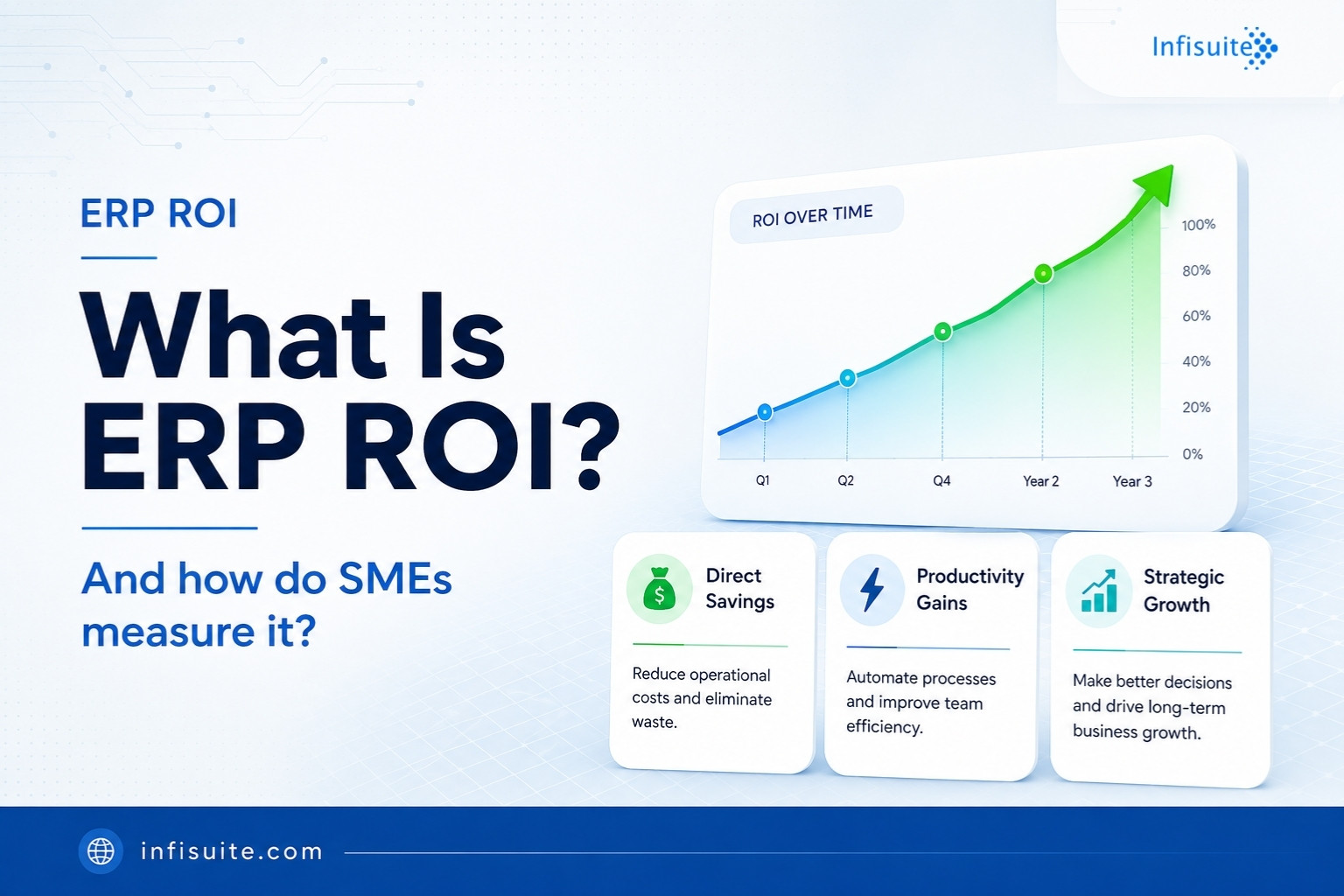
ERP ROI measures the financial value an ERP system delivers relative to its Total Cost of Ownership (TCO). Calculated using the formula ROI = (Total Benefits – Total Costs) ÷ Total Costs × 100, a successful implementation typically yields a 3-year ROI between 100% and 300%. For most growing small-to-medium enterprises (SMEs), the payback period—where the software’s cumulative operational savings and efficiency gains fully cover the upfront and ongoing costs—falls safely within 12 to 24 months.
Key Takeaways
- Include all costs, not just licenses. To measure true ROI, your Total Cost of Ownership (TCO) must calculate software subscriptions alongside implementation, data migration, hardware (if any), and training resources.
- Look beyond direct savings. The largest chunk of an ERP’s long-term return stems from indirect productivity jumps (like cutting reporting times by 50–90%) and strategic scaling milestones.
- Account for the “Cost of Doing Nothing.” Inefficient manual workarounds, data siloes, processing delays, and human calculation errors carry a compounding financial penalty that standard budgets overlook.
- User adoption is the ultimate ROI multiplier. An enterprise-grade system delivers zero financial return if your team rejects it. Investing heavily in user training directly accelerates your payback clock.
- Phased rollouts yield faster payback. Deploying your most critical operational modules first resolves high-cost pain points immediately, helping the system fund its own expansion.
Every business evaluating an Enterprise Resource Planning (ERP) system eventually faces the exact same hurdle: justifying the capital expenditure. An ERP is rarely a casual purchase. It demands a serious commitment of software fees, deployment timelines, training hours, and organizational change management.
Naturally, decision-makers must confidently answer one core question: Will this platform actually pay off?
This is where understanding ERP ROI becomes essential. Return on Investment is the financial framework that transforms a sweeping technological overhaul from a risky leap of faith into a cold, calculated business decision. Yet, ERP ROI remains widely misunderstood. Many small-to-medium enterprises (SMEs) either dramatically underestimate their returns by only counting obvious administrative hours saved, or catastrophically overestimate them by ignoring hidden implementation friction.
This guide breaks down what ERP ROI truly means, how to map out a step-by-step measurement framework, what realistic performance benchmarks look like for growing companies, and how to build an ironclad business case.
What Is ERP ROI? The Basic Formula
At its foundation, ERP ROI is a metric designed to track the net financial value an ERP platform provides relative to every rupee or dollar spent on its setup and upkeep. Stated simply: for every unit of currency poured into the system, how much value streams back into your bottom line?
The universal baseline calculation is structured as follows:
ROI (%) = [ (Total Quantifiable Benefits − Total Cost of Ownership) ÷ Total Cost of Ownership ] × 100
For context, if a modular Cloud ERP platform costs your business ₹10,00,000 across a three-year lifecycle and generates ₹25,00,000 in comprehensive operational benefits over that same period, your return calculation looks like this:
(₹25,00,000 − ₹10,00,000) ÷ ₹10,00,000 × 100 = 150% ROI
While the mathematical execution is elementary, the operational execution is where most teams falter. The challenge isn’t running the math—it’s accurately identifying, capturing, and assigning realistic values to both sides of the ledger. Getting your projections right requires peeling back the hidden layers of your business costs and operational advantages.
The Cost Side vs. The Benefit Side
Understanding Total Cost of Ownership (TCO)
To avoid projecting an inflated, unrealistic ROI model, you must account for every cost variable across a clear 3-to-5-year horizon. Focusing strictly on the software subscription invoice is a critical mistake. A true TCO model must aggregate:
- Upfront software licensing or routine SaaS subscriptions
- System integration and implementation partner fees
- Data cleaning and historical legacy migration services
- Internal team training and ongoing user onboarding pipelines
- Post-launch technical support, maintenance, and custom API configurations
For an exhaustive analysis of these variables, review our comprehensive breakdown on how much ERP costs for SMEs.
The Three Categories of ERP Benefits
The benefits side of an ERP ledger falls into three distinct buckets, ranging from easily visible to highly strategic.
1. Direct Cost Savings (Hard Returns)
These are tangible, easily auditable savings that translate directly to your cash flow statement:
- Reduced Labor Hours: Eliminating manual data entry, human data transcription, and messy cross-departmental manual reconciliations.
- Software Consolidation: Sunsetting standalone, disconnected software tools (separate billing apps, detached CRMs, or siloed inventory sheets) and replacing them with a unified system.
- Optimized Inventory Carrying Costs: Introducing end-to-end stock visibility to prevent cash from being tied up in safety stock over-purchasing.
- Reduced Data Errors: Eradicating double-billing blunders, warehouse picking slip-ups, and order entry errors that drain time and money to fix.
2. Productivity and Operational Efficiency Gains (Soft Returns)
These gains are highly impactful but require close observation to quantify accurately:
- Accelerated Financial Reporting: Shifting multi-day monthend closures into automated, real-time dashboards, instantly reclaiming senior leadership hours.
- Streamlined Order Processing: Automating the journey from an initial CRM lead down into a procurement request and final invoice.
- Workflow Bottleneck Removal: Utilizing automated system notifications to fast-track internal expense and purchase order approvals.
3. Strategic and Growth Scalability (Long-Term Value)
Often overlooked because they are the hardest to forecast, strategic benefits typically provide the largest compounding returns as an organization scales:
- Frictionless Scalability: Increasing your monthly transaction volumes or expanding service lines without needing to hire a proportional army of back-office administrative staff.
- Elevated Customer Experience: Boosting customer retention rates and lifetime value (LTV) through reliable, on-time order fulfillment.
- Audit and Due Diligence Readiness: Ensuring your accounting and compliance structures are perfectly preserved for external auditors, banking partners, or potential corporate investors.
Step-by-Step ERP ROI Calculation Framework
To construct a balanced financial model, follow this sequential structure over a standard 3-year timeline:
Step 1: Calculate Total Cost of Ownership (TCO). Aggregate your software, migration, deployment, and employee training hours into one baseline investment number.
Step 2: Quantify Direct Savings. Isolate predictable labor roll-offs. For example, if automated invoice generation saves your bookkeeping staff 30 hours a week, multiply those 30 hours by their fully burdened hourly wage, and project that out annually.
Step 3: Appraise Productivity Dividends. Estimate the commercial value of speed. If your sales representatives can process orders 25% faster, determine how that saved capacity translates into additional closed revenue opportunities.
Step 4: Factor in Strategic Scaling. Apply a conservative, grounded value to broader metrics. For instance, predict how a 2% increase in customer retention—fueled by accurate order delivery—impacts your long-term margins.
Step 5: Apply the Baseline Formula. Run your finalized totals through the standard ROI equation to identify your projected net percentage return.
Step 6: Map the Payback Window. Plot your cumulative monthly gains against your initial TCO layout to pinpoint the exact month your investment breaks perfectly even.
Realistic ERP ROI Benchmarks for SMEs
While performance patterns shift depending on operational execution and market maturity, standard middle-market deployments generally settle into these proven baseline ranges:
| Performance Metric | Typical SME Benchmark Range |
|---|---|
| Average Payback Window | 12 to 24 Months |
| 3-Year Net ROI Percentage | 100% to 300% |
| Manual Process Labor Reduction | 20% to 40% drop across optimized departments |
| Corporate Reporting Cycle Reduction | 50% to 90% faster data aggregation |
| Inventory Carrying Cost Optimization | 10% to 30% reduction in tied-up capital |
Four Critical Measurement Pitfalls to Avoid
- Evaluating in a Vacuum: Forgetting to account for the “Cost of Doing Nothing.” Operating without an ERP means accepting the compounding costs of administrative backlogs, manual workflow human errors, and missed market opportunities.
- Chasing Phantom Metrics: Counting speculative, generalized soft savings without mapping them back to a concrete, real-world business asset or hour saved.
- Demanding Overnight Payback: Treating an ERP system like a short-term patch. True systems integration returns compound exponentially over a 2-to-3-year timeline as user adoption matures.
- Failing to Set Baseline Benchmarks: Launching a platform without logging your pre-implementation KPIs. If you don’t document your exact initial error rates, cycle times, and labor hours, measuring improvement becomes impossible.
Why Infisuite is Engineered to Maximize ROI
Infisuite actively structures its automation architecture to bypass the traditional margin drains that delay financial payback for growing mid-market enterprises:
- True Modularity: Avoid paying for a bloated corporate suite. Activate only the pillars you need today—such as Core Accounts, Inventory, Procurement, or CRM—and expand your digital footprint at your own pace.
- Rapid Cloud Deployment: By eliminating local infrastructure burdens and heavy physical installations, our agile Cloud setup accelerates your time-to-value window.
- Native Interoperability: Robust APIs and built-in connectors link effortlessly into your existing tech stack, minimizing custom developer billing hours.
- Hands-On Migration Frameworks: Comprehensive data mapping and implementation consulting protect your pipeline from the classic deployment delays that threaten ROI.
Frequently Asked Questions
How fast can a business realistically expect to realize positive ERP ROI?
Most modern SMEs achieve their complete financial break-even point within 12 to 24 months post-launch. Net financial returns continue to accelerate through years 3 and 4 as workflows stabilize and manual habits are phased out.
How can we calculate a financial value for soft, non-monetary benefits?
Convert abstract efficiency into concrete labor capacity. If a management dashboard compresses a reporting workflow from 8 hours down to 1 hour, track that 7-hour dividend against the loaded salary cost of the manager, or evaluate the revenue potential of redirecting those hours toward growth initiatives.
What is the primary cause behind a failing or negative ERP ROI?
User rejection. A business can purchase the most sophisticated software architecture on earth, but if the end-users struggle with a confusing interface or receive inadequate training, they will revert to offline spreadsheets—destroying the system’s projected efficiency gains.
Should small businesses factor a phased module strategy into their ROI models?
Absolutely. Launching with high-priority modules that target your most expensive operational bottlenecks allows you to unlock rapid cash flow returns. Those early savings can then organically fund the rollout of secondary modules down the road.
Conclusion
Calculating your ERP’s true ROI shifts the entire software selection process away from an emotional product demo gamble and transforms it into a structured, data-driven business strategy. Protecting your technology margins requires analyzing your cost vectors transparently, mapping your performance gains across all three benefit tiers, and tracking your metrics over a realistic multi-year timeline.
When properly selected and tightly matched to core operational workflows, a modular ERP platform consistently delivers a secure, predictable payback window—transforming a standard business system into a highly profitable engine for long-term growth.
Written by Anjana A
ERP & Business Software Specialist, Infisuite
Anjana A writes about ERP selection, implementation, and business automation for growing SMEs. Drawing on Infisuite’s experience helping businesses evaluate and deploy cloud ERP, she focuses on practical, requirements-first guidance that helps decision-makers choose systems that fit their size, industry, and growth plans.
Ready to build an honest, data-driven business case for your operations? Connect with an Infisuite specialist today for a personalized financial consultation.