

Quick Answer
CRM (Customer Relationship Management) software turns enquiries into customers by capturing every lead in one place, tracking each one through your sales pipeline, and making sure no follow-up is missed. Instead of leads getting lost in inboxes and notebooks, every enquiry is recorded, assigned, and followed up on time. The CRM reminds your team who to call, shows where each deal stands, and keeps the full history of every conversation. The result: fewer lost leads, faster follow-ups, and more enquiries that actually become paying customers. When the CRM is connected to sales and inventory, a won deal flows straight into an order — with no re-entry.
Key Takeaways
- Most lost sales are lost to poor follow-up — not bad products or high prices.
- CRM captures every lead in one place — no more enquiries lost in inboxes, chats, or notebooks.
- A pipeline shows where every deal stands — so nothing stalls silently.
- Automated reminders mean no missed follow-ups — the CRM tells your team who to call and when.
- Connected CRM flows into sales — a won deal becomes an order with no re-entry.
Your business works hard to get enquiries. Ads, referrals, website forms, phone calls. Each one is a chance to win a customer.
So here is the uncomfortable question: what happens to those enquiries after they arrive?
In many growing businesses, the answer is “it depends.” Some get followed up. Some get forgotten. Some sit in an inbox until the customer buys elsewhere. That gap is where sales are lost — and it is exactly what CRM software fixes.
What Is CRM Software?
CRM stands for Customer Relationship Management. CRM software is a tool that stores all your leads and customers in one place, and helps you manage every interaction with them.
Think of it as one shared memory for your whole sales team. Every enquiry, every call, every follow-up, every deal — all recorded, all visible, all in one system. As industry leader Salesforce explains, a CRM gives every team a single, shared view of each customer.
Without a CRM, that information lives in scattered places: one person’s email, another’s phone, a notebook, a spreadsheet. When information is scattered, leads slip through the cracks.
Why Enquiries Get Lost Without a CRM
Losing a lead rarely happens on purpose. It happens because of small gaps that add up:
- The enquiry lands in one inbox. One person sees it. If they are busy or away, it waits.
- Nobody owns the follow-up. Everyone assumes someone else will call. No one does.
- The history is lost. A customer calls back, and no one remembers the last conversation.
- There is no reminder. A promising lead needed a call in three days. Nobody remembered.
- No one can see the full picture. The manager cannot tell which deals are close and which are stuck.
Each gap is small. Together, they cost real sales. And the business often never even knows it lost them.
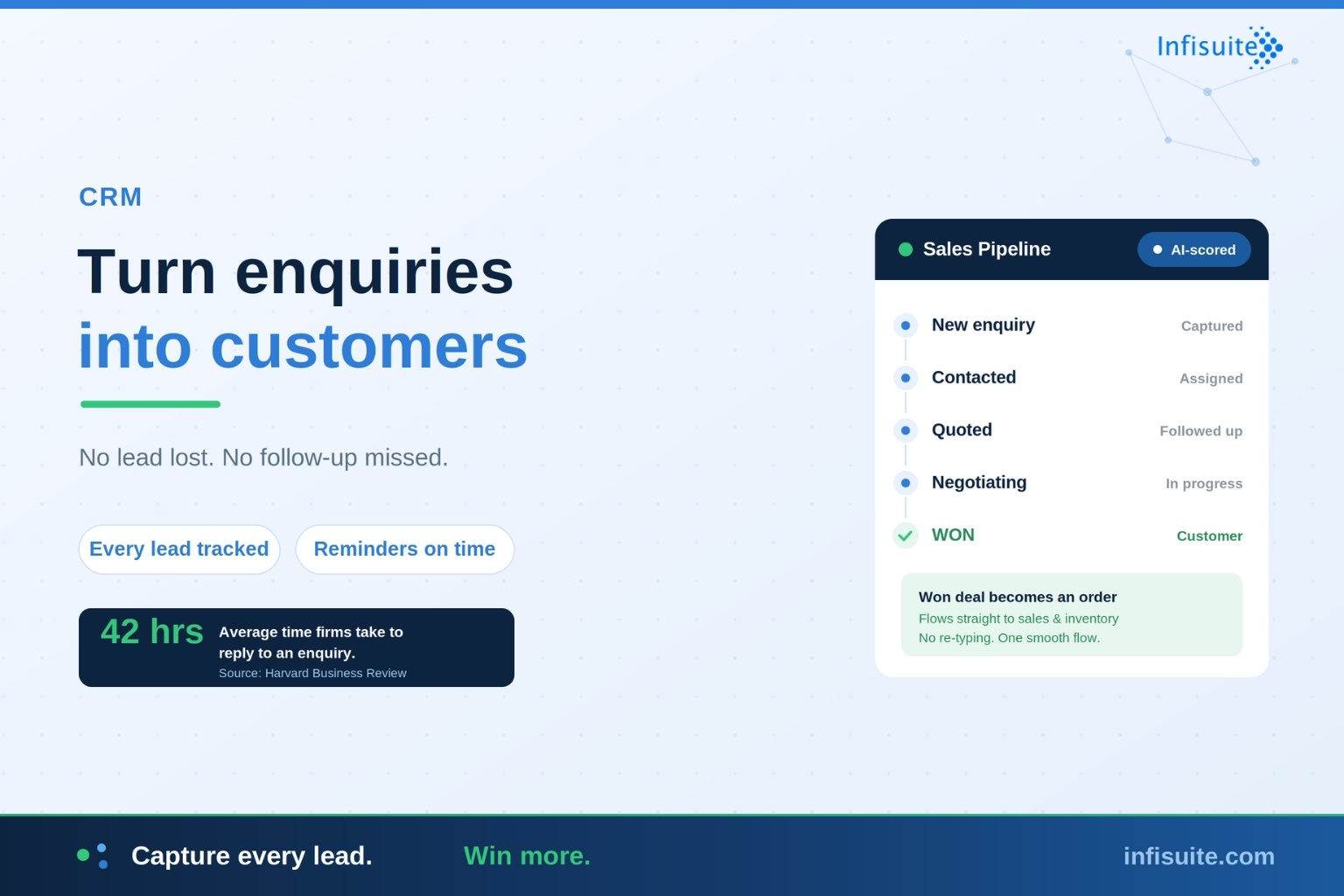
The data on this is striking. A widely cited Harvard Business Review study of 2,241 companies found the average business took 42 hours to respond to a web enquiry — and 23% never responded at all. Yet firms that reply within an hour are far more likely to win the deal. Speed matters, and manual systems are slow.
How CRM Turns an Enquiry Into a Customer
A CRM guides every enquiry through a clear journey. Here is how it works, step by step.
1. Capture — no lead is lost
Every enquiry enters the CRM automatically, from any source: website form, email, phone, or social media. Nothing depends on one person’s inbox. The lead is recorded the moment it arrives.
2. Assign — someone owns it
The lead is assigned to a salesperson. Now one clear person is responsible for following up. No more “I thought you had it.”
3. Track — the pipeline shows the stage
Each lead moves through stages: New, Contacted, Quoted, Negotiating, Won or Lost. Anyone can see exactly where a deal stands at a glance.
4. Follow up — reminders keep it moving
The CRM reminds the salesperson when to call, when to send a quote, and when to check back. Follow-ups happen on time, not by luck.
5. Convert — the deal becomes an order
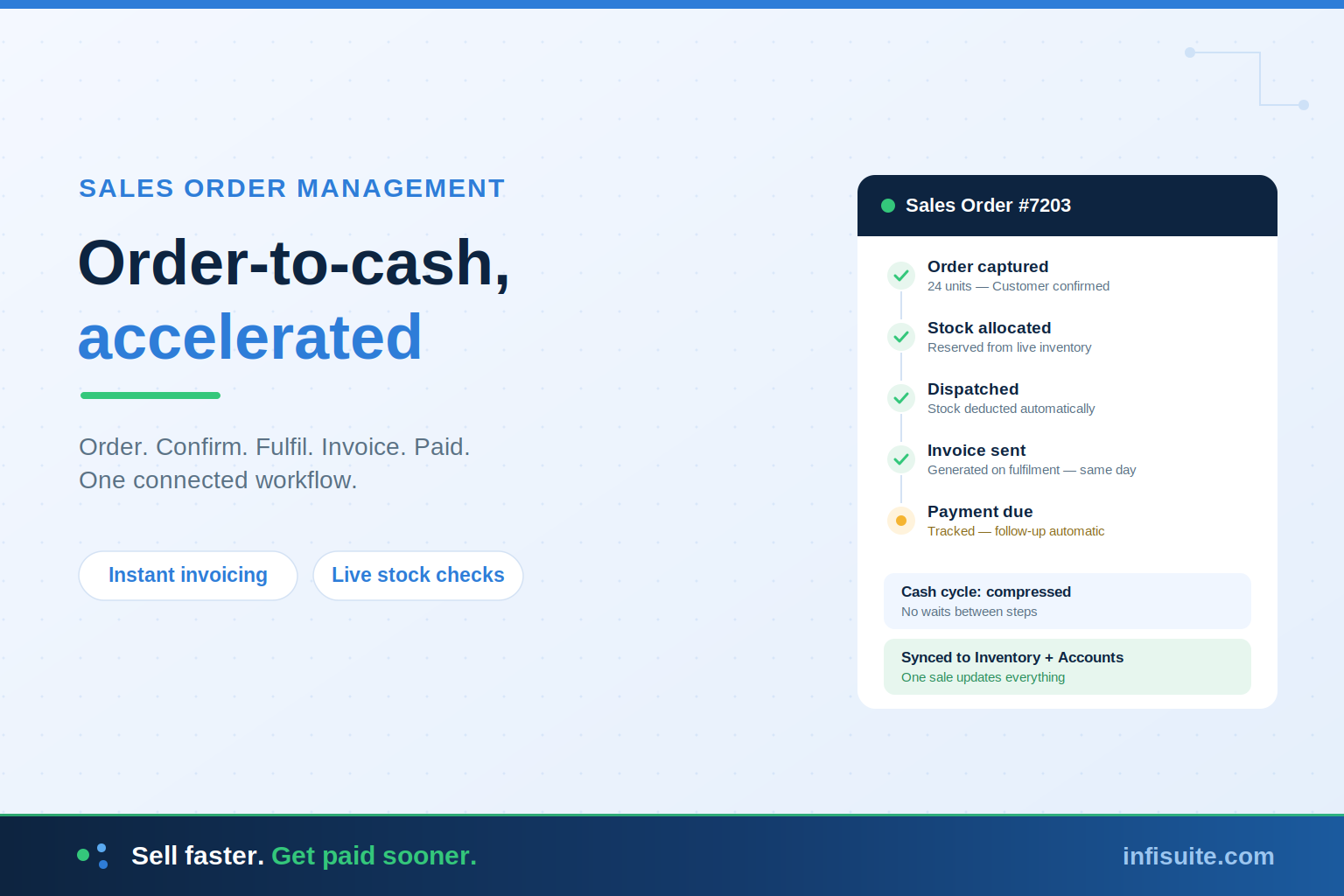
When the deal is won, it turns into a sales order. On a connected platform, this flows straight into fulfilment — no re-typing the details.
With a CRM vs Without One
| Stage | Without a CRM | With a CRM |
|---|---|---|
| New enquiry | Lands in one inbox | Captured automatically |
| Ownership | Unclear — anyone or no one | Assigned to one person |
| Follow-up | Depends on memory | Reminders sent automatically |
| History | Scattered or lost | Full record in one place |
| Pipeline view | No clear picture | Every deal visible by stage |
| Won deal | Re-typed into orders | Flows straight to sales |
How AI Makes CRM Smarter
A modern CRM does more than store data. AI helps your team sell better.
- Lead scoring. AI ranks leads by how likely they are to buy, so your team focuses on the best ones first.
- Next-step suggestions. The CRM suggests the best action for each lead — call now, send a quote, wait a day.
- Follow-up drafts. AI can draft follow-up emails, so replies go out faster.
- Pipeline insights. AI spots deals that are going cold and flags them before they are lost.
Why a Connected CRM Wins
A standalone CRM helps you manage leads. But it stops at the sale.
Here is the problem. When a deal is won, someone has to turn it into an order. In a disconnected setup, that means re-typing the customer, the products, and the prices into a separate system. Slow, and error-prone.
A connected CRM is different. It shares one platform with sales, inventory, and accounts. So when a deal is won:
- The sales order is created from the deal — no re-typing.
- Stock is checked and reserved automatically.
- The invoice follows, and the books update.
This is where CRM meets the order-to-cash cycle. The CRM wins the deal. The connected platform delivers it. One smooth flow, from first enquiry to final payment.
This is how Infisuite’s CRM module works. It captures leads, manages the pipeline, and connects directly to sales, inventory, and accounts — so a won deal becomes a fulfilled order with no gaps in between.
Who Needs a CRM?
You likely need a CRM if:
- Leads come from many sources and are hard to track
- Follow-ups depend on memory or sticky notes
- You cannot say how many open deals you have right now
- Customer history is lost when a salesperson is away
- Enquiries sometimes go unanswered
If any of these sound familiar, leads are slipping away. A CRM stops the leak. For the bigger picture, see our guide on when businesses actually need an ERP system.
Frequently Asked Questions
What is CRM software?
CRM (Customer Relationship Management) software stores all your leads and customers in one place, and helps you manage every interaction with them. It captures enquiries, tracks them through a sales pipeline, and reminds your team to follow up — so fewer leads are lost.
How does a CRM help increase sales?
A CRM makes sure no enquiry is lost and no follow-up is missed. Every lead is captured, assigned to a person, and tracked through clear stages with automatic reminders. Faster, more consistent follow-up turns more enquiries into customers.
What is a sales pipeline?
A sales pipeline is the set of stages a deal moves through, such as New, Contacted, Quoted, Negotiating, and Won or Lost. A CRM shows every deal’s stage at a glance, so you always know where each one stands.
What is the difference between CRM and ERP?
A CRM manages leads and customer relationships. An ERP runs your whole business, including sales, inventory, and accounts. A connected CRM is part of the ERP, so a won deal flows straight into an order without re-entry.
Does a small business need a CRM?
Yes, if it handles more leads than one person can track by memory. Even small teams lose sales to missed follow-ups. A CRM captures every enquiry and keeps follow-ups on schedule, which pays off quickly.
Conclusion
Every enquiry is money at the door. The question is whether you let it in.
Without a system, leads get lost in inboxes and forgotten follow-ups. The sale goes to whoever called back first — often a competitor.
A CRM fixes this. It captures every lead, assigns an owner, tracks each deal, and reminds your team to follow up. And when it is connected to sales and inventory, a won deal becomes an order in one smooth flow.
More enquiries become customers. Fewer sales slip away. That is what a CRM is really for.
Written by Anjana A
ERP & Business Software Specialist, Infisuite
Anjana A writes about ERP, CRM, and business automation for growing SMEs. She focuses on clear, practical guidance that helps businesses win more customers and run connected operations without complexity.
Want every enquiry to get followed up? Talk to the Infisuite team to see the CRM module in action.