

Quick Answer
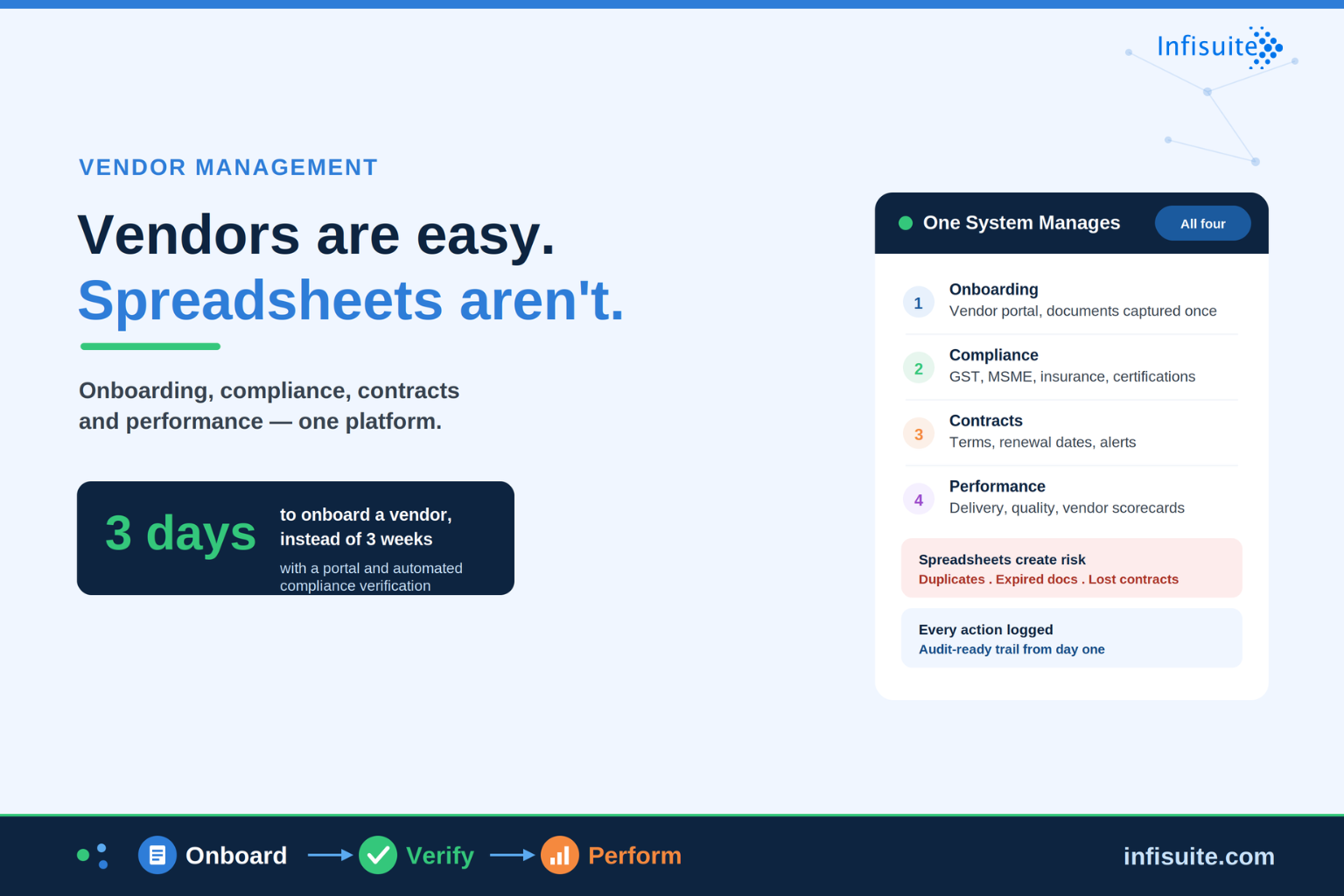
The vendor onboarding process is the sequence a business follows to qualify, verify, and activate a new supplier: identifying the vendor, collecting documents, verifying statutory compliance (GST, MSME, TDS, labour laws), negotiating terms, obtaining internal approvals, creating the ERP master record, and reviewing initial transaction performance. In India, manual onboarding typically takes two to three weeks, largely due to internal delays in document collection and sequential approval queues.
Key Takeaways
- Most onboarding delay is internal. Vendors usually submit documents quickly; time is lost chasing missing items, manually checking tax portals, and waiting on sequential email approvals.
- Not every vendor needs the same process. Tiering by risk and spend allows low-value suppliers to onboard in 2–3 days while reserving deep diligence for strategic partners.
- Tax and statutory checks must occur before contract signing. Validating GST status, TDS applicability (Section 206AB / 197), and MSME status during onboarding prevents costly tax mismatches later.
- Indian labour compliance has clear employee thresholds. EPFO applies at 20+ employees; ESIC at 10+ employees with wages up to Rs. 21,000 per month. Onboarding must check these for site and manpower vendors.
- MSME status imposes statutory payment obligations. Under the MSMED Act, payment is due within 15 days where there is no written agreement, and within the agreed period up to a maximum of 45 days where one exists.
- Compliance verification requires continuous monitoring. One-off onboarding checks do not protect against subsequent GST cancellations, MSME expiry, or lapsed insurance policies.
Ask a procurement team why vendor onboarding takes three weeks and the answer is usually some version of “vendors are slow to send documents.”
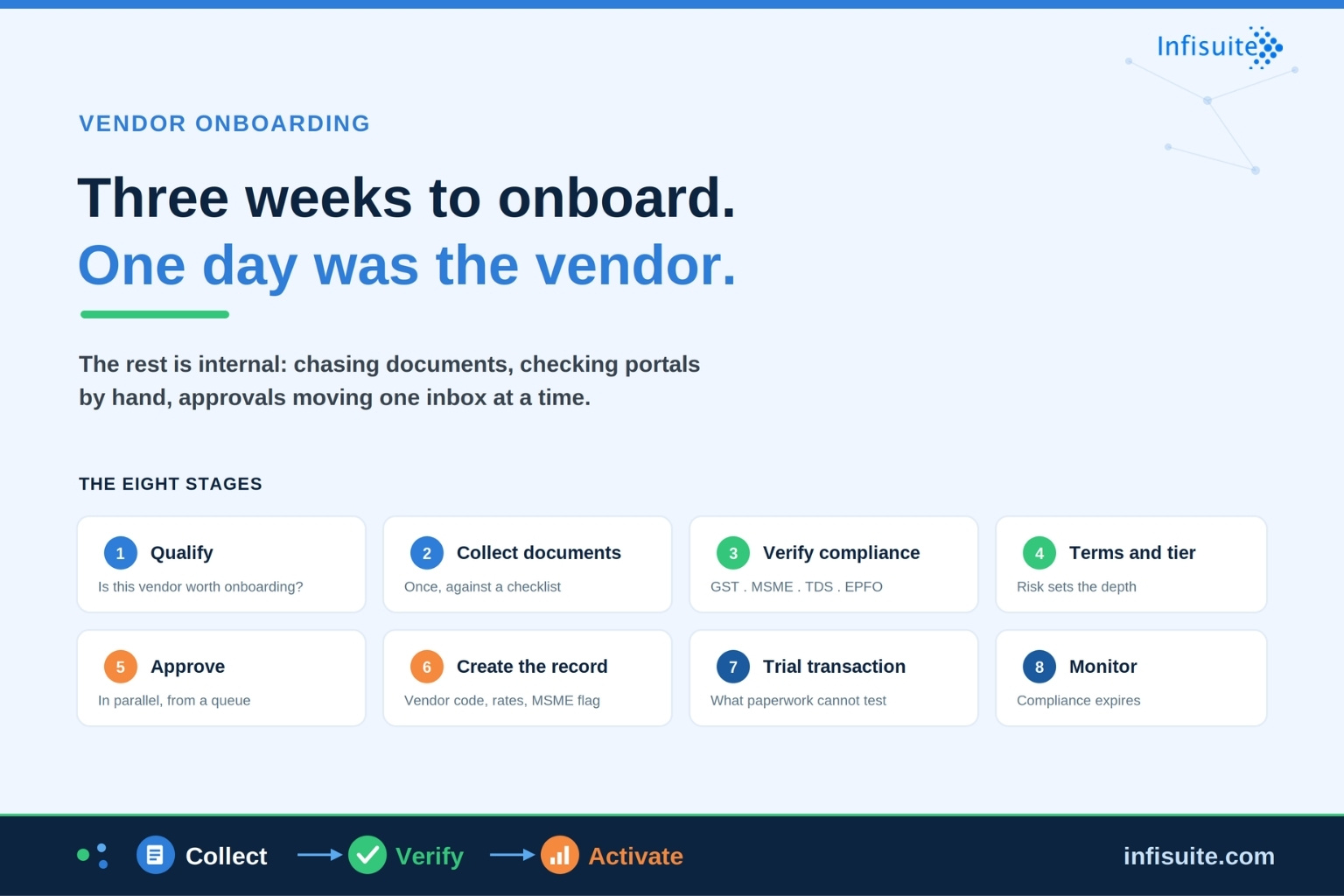
Measure it properly and a different picture emerges. The vendor sent their documents the day after they were asked. Two were missing, so someone emailed back, and that round-trip took four days. Compliance verification took an afternoon of work spread across nine days because the person doing it had other priorities. Then three approvals moved one after another, each sitting in an inbox until it was noticed.
The vendor was waiting for one of those days. The organisation was waiting for the rest.
That distinction matters, because it changes what you fix. You cannot chase a vendor into being faster. You can remove a queue.
What Is Vendor Onboarding?
Vendor onboarding is the process of qualifying, verifying, and activating a new supplier so they can legally and operationally do business with your company. It covers everything from initial identification through to the vendor record being live in your systems and the first transaction being reviewed.
It is distinct from procurement, which handles what you buy, and from accounts payable, which handles how vendors get paid. Onboarding establishes whether a vendor should be doing business with you at all, on what terms, and with what evidence on file.
Done well, it produces three things: a vendor who can transact without friction, a documented basis for having approved them, and a record complete enough to answer an audit question two years later.
The Vendor Onboarding Process, Step by Step
Step 1 — Identify and qualify the vendor
Before any documentation is collected, establish that this vendor is worth onboarding. That means a defined business need, a check on whether an existing approved vendor already covers it, and a basic view of the vendor’s capability and standing.
For routine categories, a simple qualification note is sufficient. For strategic or high-spend categories, a Request for Information (RFI) gathers capability, capacity, and reference details before committing effort to full onboarding.
This step prevents the most wasteful outcome in vendor management: fully onboarding a supplier who duplicates one you already have.
Step 2 — Collect documentation
For an Indian vendor, the standard set includes:
- Vendor information form with entity details, contacts, and category of supply
- PAN card
- GST registration certificate (where applicable)
- Certificate of Incorporation, Partnership Deed, or Proprietorship proof
- Cancelled cheque or bank account verification letter
- Udyam registration certificate (if the vendor is an MSME)
- EPFO and ESIC registration proof (where applicable based on headcount)
- Lower or nil TDS deduction certificate under Section 197 (if held)
- Trade licences or category-specific safety and quality certifications
- Insurance certificates (for vendors operating on your premises)
The common failure here is collecting these by email. A vendor sends six of ten documents, someone notices four are missing, emails back, and waits. Two or three round-trips are normal and each one costs days.
A structured submission portal or checklist that rejects incomplete sets removes most of this friction. The vendor sees what is outstanding immediately.
Step 3 — Verify statutory compliance
Documents on file are not the same as documents verified. Four checks matter most for Indian vendors:
GST registration status. A GSTIN can be verified against the GST portal’s Search Taxpayer service to confirm legal name, active status, and filing compliance. A cancelled or inactive GSTIN on a vendor you pay creates immediate Input Tax Credit (ITC) loss exposure.
MSME classification. Verify certificates against the Udyam Registration portal. Beyond paperwork, MSME classification triggers statutory payment protection, and public sector buyers work to procurement targets for MSME sourcing.
Labour law compliance. Vendors supplying manpower or performing site work must hold valid employee registrations. EPFO registration applies at 20 or more employees, while ESIC applies at 10 or more employees earning up to Rs. 21,000 per month. Unverified vendors expose your organisation to principal employer liability.
Tax Deduction at Source (TDS) checks. Under Section 206AB of the Income Tax Act, higher TDS rates apply to vendors who have not filed income tax returns for the specified periods. Verify return filing status using the Income Tax department’s compliance check utility. Additionally, log any Section 197 lower or nil deduction certificates along with their validity windows to prevent incorrect quarterly deductions.
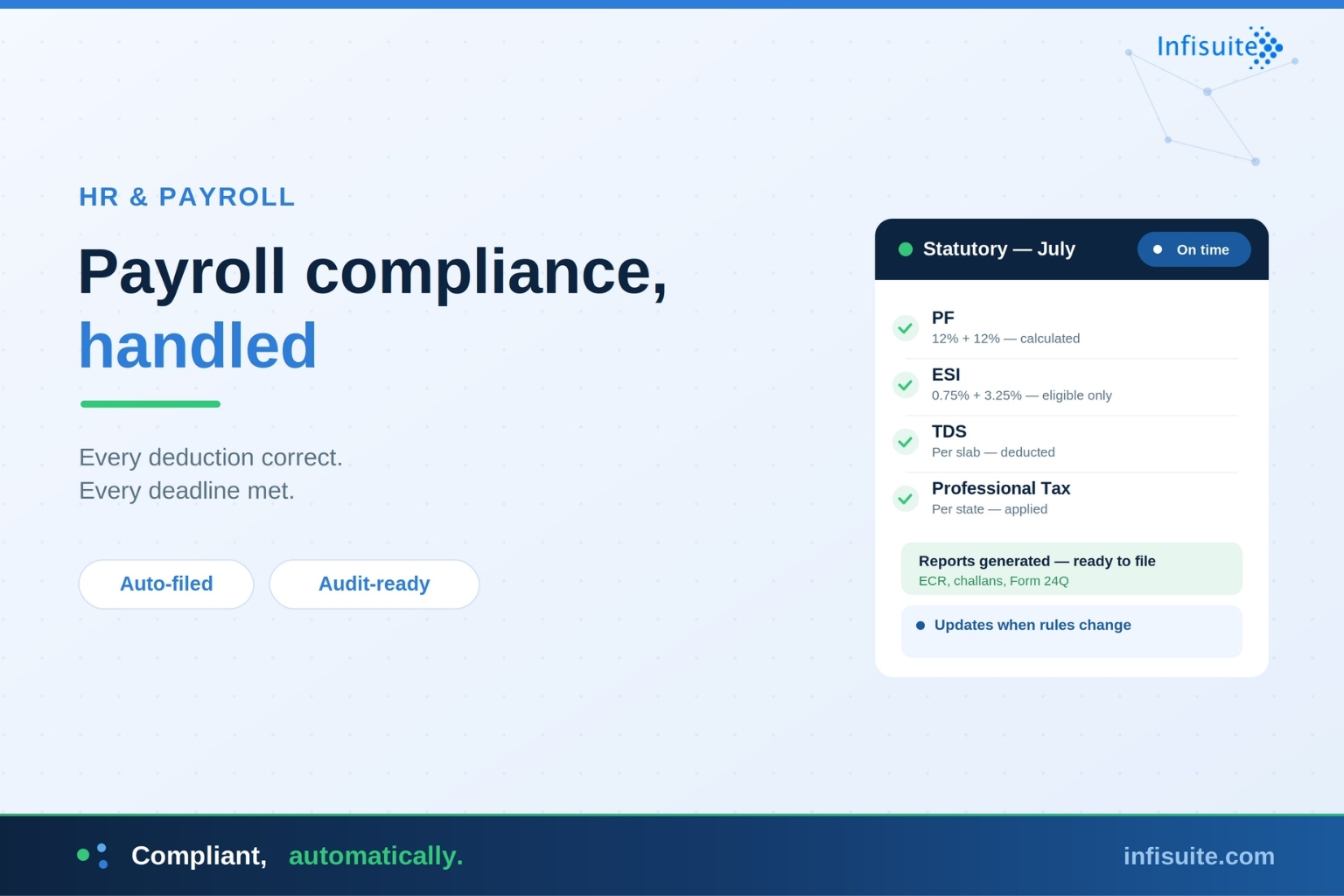
The same discipline applies to your internal operations — the thresholds involved in payroll compliance follow identical statutory logic.
Step 4 — Finalise terms, assess risk and tier the vendor
Not every vendor warrants the same level of scrutiny. Running a stationery supplier through the same due diligence as a strategic manufacturing partner wastes weeks and provides zero added safety.
At this stage, commercial terms (pricing, SLAs, deliverables, and NDAs) are established. For MSME vendors, payment terms must respect the statutory timelines under the MSMED Act — 15 days where there is no written agreement, and no more than 45 days where one exists. Vendors are then assigned a risk tier to determine required approval levels:
| Tier | Typical Vendor | Onboarding & Legal Scrutiny |
|---|---|---|
| Low risk | Low-value, easily replaced, no site access | Core tax documents, automated verification, standard terms, single approval |
| Standard | Recurring supply, moderate spend | Full document set, statutory portal validation, bilateral SLA, dual approval |
| High risk or strategic | High spend, site access, data handling, single-source | Full set plus financial audit, site visit, custom legal contract, executive sign-off |
Proper tiering lets low-risk suppliers go live in two days while reserving rigorous controls for high-risk vendors.
Step 5 — Route for internal approvals
Approvals are where most onboarding processes stall, usually because requests move sequentially through email. Procurement approves, emails finance, finance approves, and emails the category owner.
Replacing sequential handoffs with parallel approval routing from a shared queue eliminates inbox lag. Approvers can review documents simultaneously, and any stakeholder can check real-time status without chasing updates.
Step 6 — Create the ERP master record
Once approved, the vendor record is activated in your Enterprise Resource Planning (ERP) or accounting software (such as SAP, Oracle, or Tally).
Assign a unique vendor code and configure bank details, verified GSTIN and PAN data, TDS deduction rates, and MSME flags. Integrating this data directly into your procurement and accounts payable modules ensures smooth PO generation and automated three-way invoice matching.
Step 7 — Run a trial transaction
A trial order tests operational capability in ways paperwork cannot: whether the vendor delivers on schedule, meets quality specifications, provides accurate GST invoices, and resolves issues quickly.
Identifying an operational friction point on a small trial order is far better than discovering it during a mission-critical delivery run.
Step 8 — Monitor compliance and performance continuously
Onboarding compliance has an expiration date. A GSTIN verified today can be cancelled next month; MSME certificates, trade licences, and insurance policies expire over time.
Continuous monitoring tracks document expiration dates automatically, triggering alerts before lapse, and records ongoing vendor metrics such as lead times and invoice accuracy as transactions occur.
A Realistic Onboarding Timeline
With a structured process and risk-tiered depth, onboarding timelines collapse significantly:
| Phase | Low-Risk Vendor | Strategic / High-Risk Vendor |
|---|---|---|
| Qualification and RFI | Same day | 2 to 5 days |
| Document collection | 1 day | 1 to 3 days |
| Statutory verification (GST / TDS) | Same day | 2 to 4 days |
| Contracting and approvals | 1 day | 3 to 7 days |
| ERP master setup | Same day | 1 to 2 days |
Where Onboarding Processes Break Down
Collecting documents via unstructured email. Partial files cause endless back-and-forth round-trips.
Manual portal validation. Manually typing GSTINs, PANs, and bank details across multiple government portals wastes hours per vendor.
Sequential approval chains. Requests sit stagnant in individual inboxes rather than moving through parallel workflows.
Uniform due diligence. Applying strategic-level auditing to low-spend suppliers slows the entire business unnecessarily.
One-time verification mindset. Failing to track post-onboarding tax cancellations or certificate expirations creates severe compliance exposure.
How to Measure Onboarding Efficiency
Track three core metrics to uncover process bottlenecks:
Internal vs. external cycle time. Measure total days from request to ERP activation, separating vendor response time from internal processing time. The internal duration highlights your operational bottlenecks.
First-pass yield (FPY). The percentage of vendors who submit a complete, compliant document set on the first attempt. A low rate indicates unclear vendor instructions.
Active compliance currency. The percentage of active ERP vendors whose tax records and licences are valid today.
Frequently Asked Questions
How long should vendor onboarding take in India?
For low-risk vendors using automated tools, two to three days is achievable. Strategic suppliers requiring site audits and contract negotiations typically take two to three weeks.
What documents are mandatory for onboarding Indian vendors?
Key requirements include PAN, GST registration, bank account proof (cancelled cheque), entity registration proof, Udyam MSME certificate (if applicable), Section 206AB TDS status, EPFO and ESIC registrations, and executed agreements and NDAs.
How do I verify a vendor’s GST status?
Use the Search Taxpayer feature on the official GST portal using the vendor’s 15-digit GSTIN. Verify that the legal entity name matches your contract and that the filing status is active.
Why is Section 206AB TDS verification required during onboarding?
Section 206AB mandates higher TDS deduction rates for non-filers of income tax returns. Verifying their status via the Income Tax portal during onboarding ensures your accounts payable team deducts tax at the correct rate from day one.
How does MSME registration affect vendor payment terms?
Under the MSMED Act, payment to a registered MSME supplier is due within 15 days where there is no written agreement, and within the agreed period up to a maximum of 45 days where one exists. Verifying Udyam certificates early ensures payment terms are set compliantly rather than corrected later.
What is the difference between vendor onboarding and vendor management?
Onboarding is the process of bringing a vendor in. Vendor management is everything after — compliance monitoring, performance tracking, contract renewals, and the relationship over time. Onboarding is a project; management is ongoing.
Should every vendor go through the same onboarding process?
No. Applying identical due diligence to every vendor slows low-risk onboarding without improving control where risk actually sits. Tier vendors by spend, replaceability, site access, and data handling, then set onboarding depth accordingly.
Can vendor onboarding be automated?
Yes. Portals can automate document submission, cross-check GST and TDS records directly against government databases, route approvals in parallel, and trigger automatic licence expiration alerts. What cannot be automated is the commercial judgement of whether this is the right vendor.
Conclusion
The vendor onboarding process is often described as a series of steps, but in practice it is a series of queues. Total cycle time is determined by how long requests wait between steps rather than the execution time of the steps themselves.
To optimise onboarding: collect document sets via standardised intake portals, verify statutory compliance against official records, run parallel approvals, and enforce dynamic risk tiering.
Streamlining onboarding builds a foundation for long-term supplier success — ensuring clean audit trails, strong contract compliance, and frictionless payments.
Written by Anjana A
ERP & Business Software Specialist, Infisuite
Anjana A writes about ERP, procurement, and business operations for growing Indian enterprises, focusing on how software reduces manual work and mitigates compliance risk.
Structured onboarding workflows, compliance document tracking, and vendor performance history in one place — see how Infisuite Vendor Management handles the vendor lifecycle.