

Quick Answer
Cloud ERP is hosted by the vendor and accessed over the internet on a subscription — low upfront cost, fast deployment, automatic updates, and easy scaling. Traditional (on-premise) ERP runs on your own servers — full control and deep customisation, but high upfront investment and ongoing IT overhead. For most SMEs and growing businesses, Cloud ERP is the more practical choice: it goes live in weeks, needs no internal IT infrastructure, and scales as you grow. Traditional ERP suits large enterprises with complex workflows or strict data-hosting requirements.
Key Takeaways
- Cloud ERP = subscription, vendor-managed, fast to deploy. Weeks to go live, not months.
- Traditional ERP = owned infrastructure, full control. Higher cost, more IT responsibility.
- Cost structures differ fundamentally — predictable subscription vs large capital outlay.
- Cloud wins on scalability and remote access — critical for growing, multi-location, or hybrid teams.
- For most SMEs, Cloud ERP is the right choice. Traditional fits enterprises with strict data-control needs.
If you’re planning an ERP implementation, one decision will shape everything that follows: Cloud ERP or Traditional (On-Premise) ERP?
Both systems are designed to streamline business operations, improve visibility across departments, and drive efficiency. But they differ significantly in how they’re deployed, maintained, scaled, and priced. According to Gartner, ERP remains one of the most critical technology investments a business can make — which is exactly why choosing the right deployment model matters.
This guide breaks down the key differences so you can make an informed decision based on your business size, budget, IT capabilities, and growth goals.
What Is Cloud ERP?
Cloud ERP is hosted on remote servers and delivered over the internet. Instead of installing software on your own hardware, your team accesses the system through a browser or app — from anywhere, at any time.
According to SAP, Cloud ERP has seen rapid adoption among SMEs and growing enterprises because it eliminates the need for costly infrastructure while offering enterprise-grade functionality.
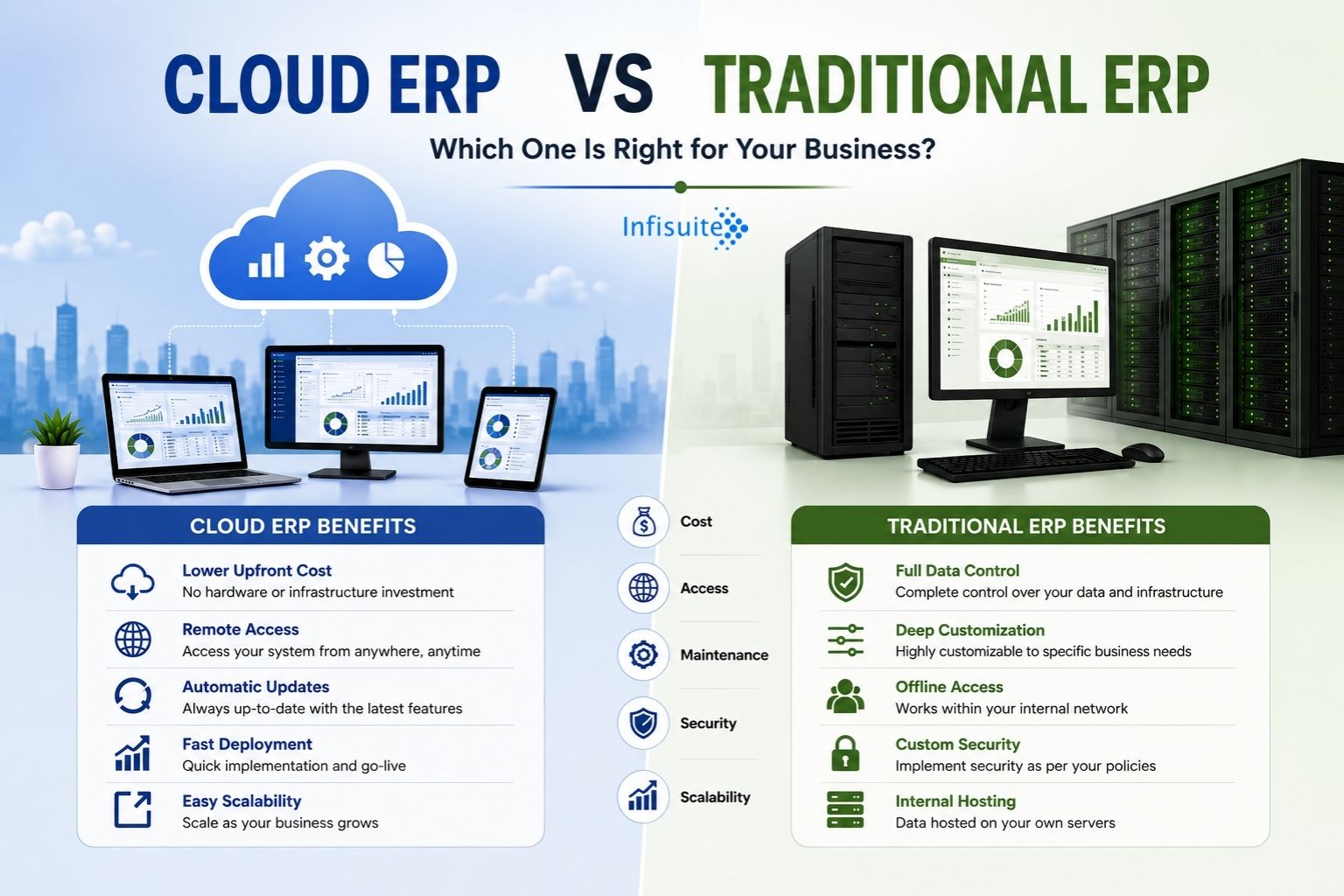
Key benefits of Cloud ERP:
- No large upfront hardware investment
- Access from any device, anywhere
- Automatic software updates and patches
- Faster deployment (weeks vs. months)
- Easily scalable as your business grows
What Is Traditional (On-Premise) ERP?
Traditional ERP, also called on-premise ERP, is installed and run on servers that your business owns and manages internally. Your IT team is responsible for everything — from updates and security patches to backups and hardware maintenance.
As Oracle explains, this model gives businesses maximum control over their infrastructure and data, but it comes at a cost: higher upfront investment and ongoing IT overhead.
Key benefits of Traditional ERP:
- Full control over data and infrastructure
- Highly customizable to specific business workflows
- No dependency on internet connectivity
- Tailored internal security configurations
Cloud ERP vs Traditional ERP: Side-by-Side Comparison
| Feature | Cloud ERP | Traditional ERP |
|---|---|---|
| Deployment | Remote (internet-based) | On-site (company servers) |
| Upfront cost | Low | High |
| Ongoing cost | Monthly/annual subscription | IT staff + hardware maintenance |
| Implementation time | Weeks | Months to years |
| Scalability | Easy and fast | Requires hardware upgrades |
| Remote access | Built-in | Requires additional setup |
| Maintenance | Managed by vendor | Managed internally |
| Customization | Moderate | High |
| Data control | Vendor-hosted | Fully in-house |
| Best for | SMEs, growing businesses | Large enterprises with complex needs |
Cost Comparison: Which ERP Is More Affordable?
Cost is often the deciding factor — and the two models are structured very differently.
Cloud ERP operates on a subscription model (SaaS). You pay a predictable monthly or annual fee that typically covers software, hosting, support, and updates. There’s no need to invest in servers or hire a dedicated IT team to manage infrastructure.
Traditional ERP involves significant upfront capital expenditure. Businesses must budget for:
- Server hardware and networking equipment
- Software licensing fees
- Implementation and customization costs
- Ongoing IT staff salaries
- Hardware refresh cycles every few years
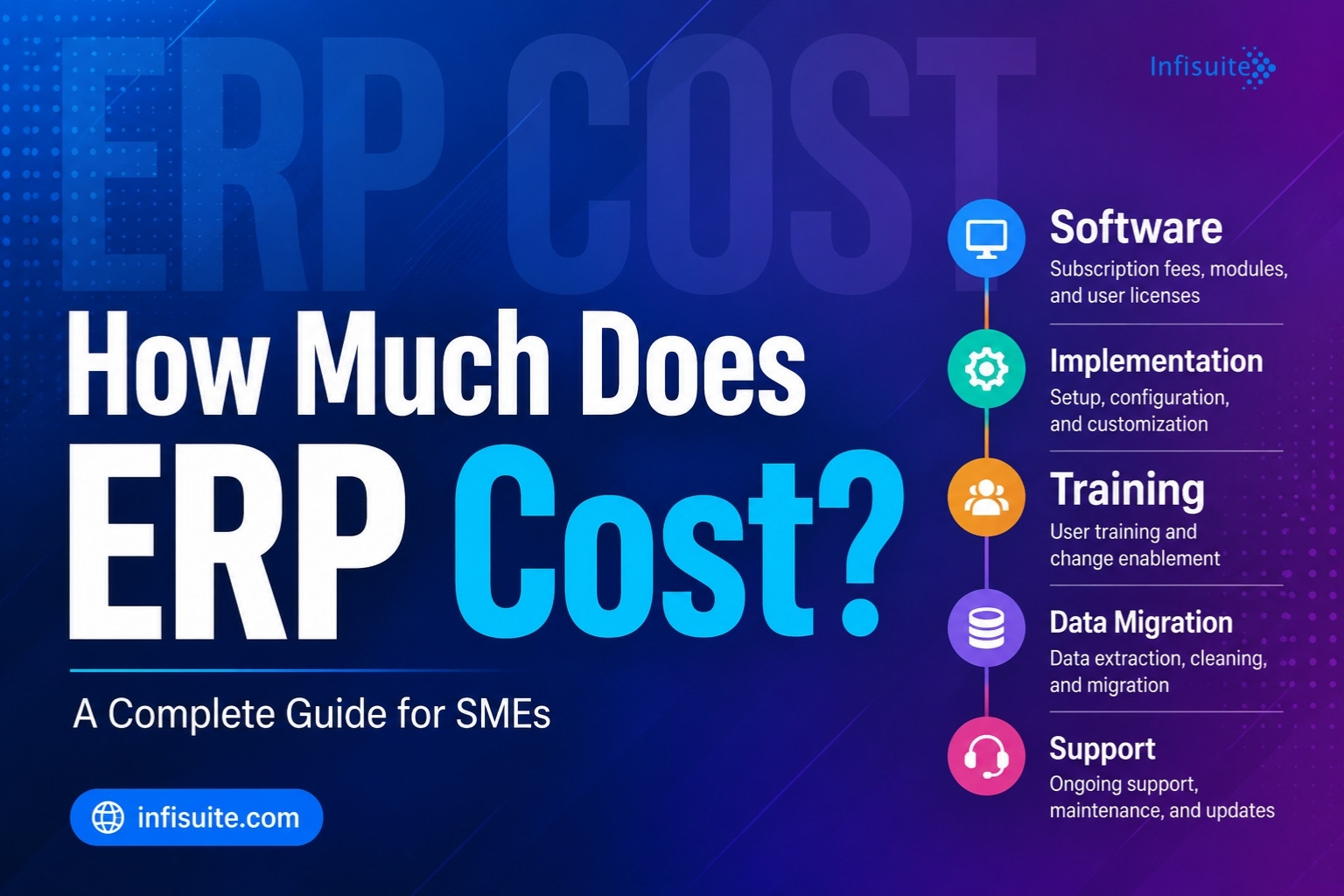
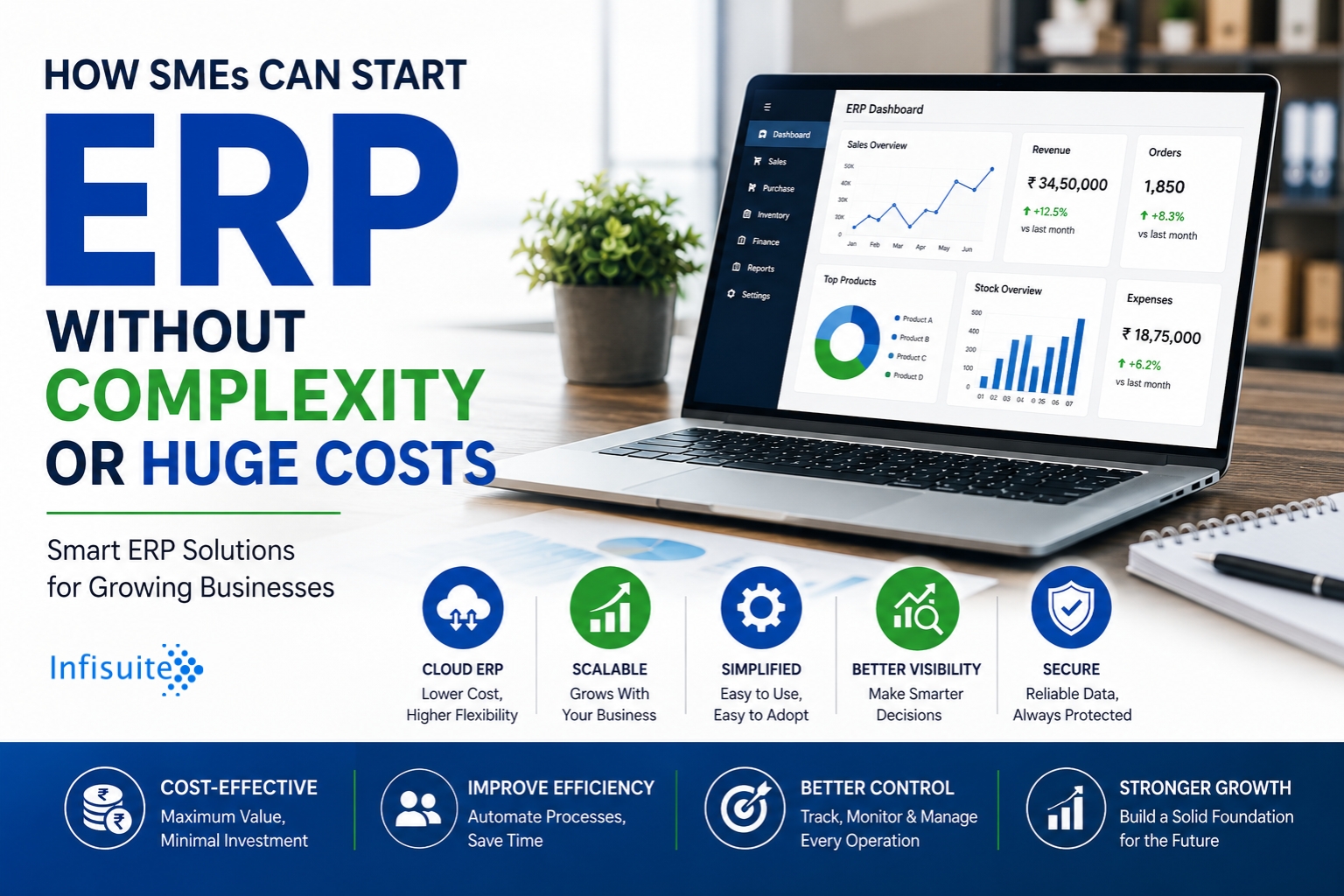
For SMEs or businesses with limited capital, Cloud ERP is generally the more financially viable option. For a full cost breakdown, read our guide on how much ERP costs, and if your team is evaluating options, see how SMEs can start ERP without complexity to understand practical first steps.
Accessibility: Working From Anywhere
Post-pandemic, remote and hybrid work has become the norm for many businesses. This is where Cloud ERP holds a clear advantage.
Cloud ERP allows employees to access real-time business data from any location with an internet connection — whether they’re at a branch office, working from home, or on the road.
Traditional ERP systems, by contrast, are typically tied to the internal company network. Remote access is possible but usually requires additional infrastructure such as VPNs, which adds complexity and cost.
Cloud ERP is especially valuable for:
- Businesses with multiple office locations
- Sales and field operations teams
- Companies with remote or hybrid workforces
- Organizations expanding into new geographies
Scalability: Growing Without Limits
Scalability is one of the strongest arguments for Cloud ERP. As your business grows — more users, more transactions, more locations — Cloud ERP scales with you. Adding new users or modules typically takes hours, not weeks.
Traditional ERP scaling is a different story. Growth often means purchasing additional servers, upgrading hardware, and paying for new software licenses — all of which takes time and budget.
If your business is on a growth trajectory, Cloud ERP’s scalability can be a significant competitive advantage. Explore Vendorstaq ERP — our cloud-based ERP built specifically for growing businesses that need scalability without infrastructure complexity.
Maintenance and IT Management
With Cloud ERP, the vendor handles software updates, security patches, server maintenance, and backups. Your internal team doesn’t need to manage any of it.
With Traditional ERP, all of that falls on your IT department:
- Scheduling and applying software updates
- Managing security vulnerabilities
- Performing regular backups
- Maintaining aging hardware
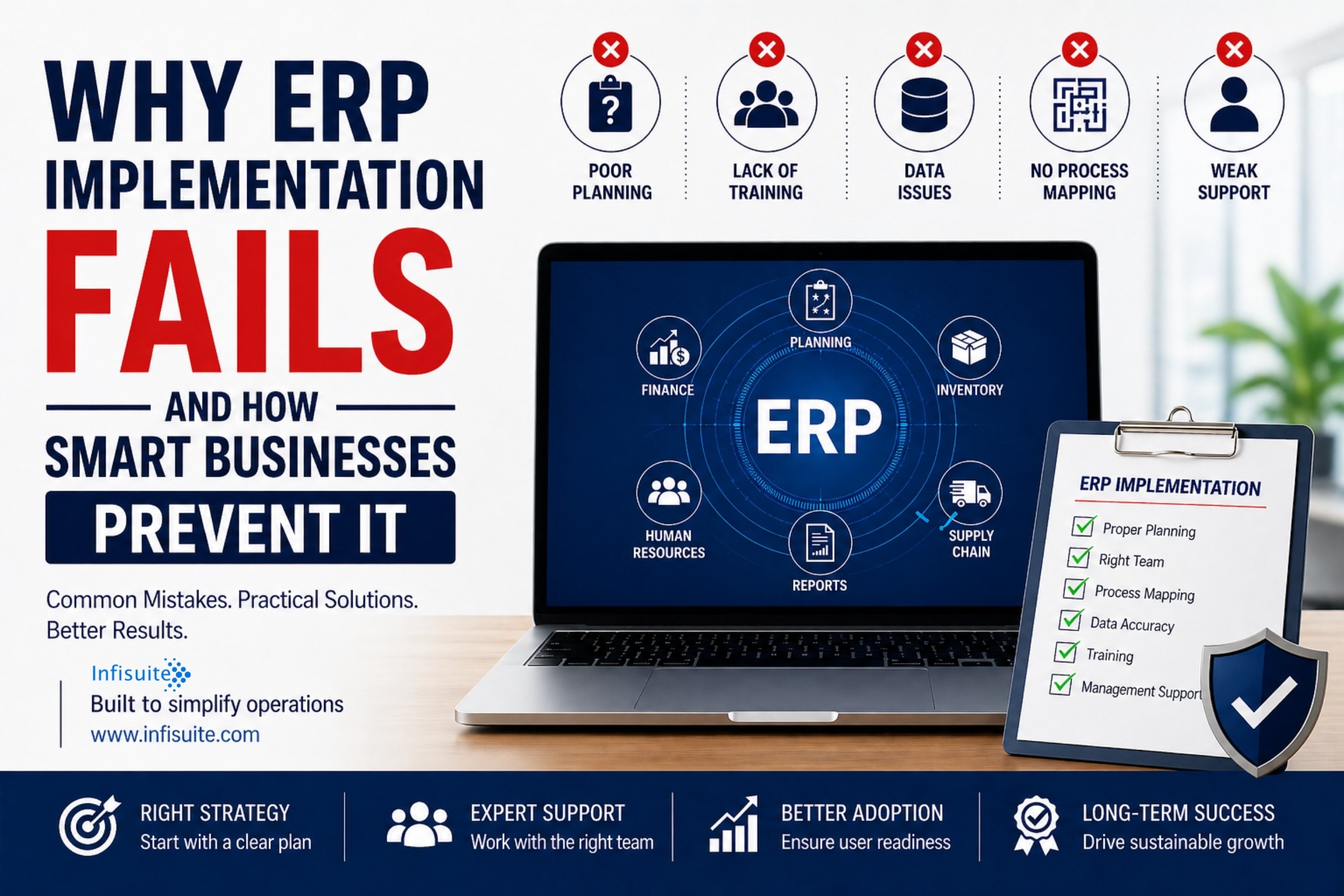
This makes Traditional ERP resource-intensive. It works well for large enterprises with dedicated IT teams, but it can strain smaller businesses. In fact, poor maintenance planning is one of the leading reasons ERP implementations fail — a risk that Cloud ERP significantly reduces.
Security: Who Keeps Your Data Safe?
Security is a common concern when evaluating Cloud ERP. Many businesses worry about hosting sensitive data on external servers. However, leading Cloud ERP providers invest heavily in enterprise-grade security, including:
- End-to-end data encryption
- Multi-factor authentication
- 24/7 security monitoring
- Automated backups and disaster recovery
- Compliance with global data regulations including GDPR and ISO 27001
Traditional ERP gives you full control over your security infrastructure — which is valuable if you operate in a highly regulated industry or have specific data sovereignty requirements.
Bottom line: Cloud ERP security is robust for most businesses. Traditional ERP may be preferable if your industry mandates internal data hosting.
Which ERP Is Right for SMEs?
For most small and mid-sized businesses, Cloud ERP is the more practical choice. Here’s why:
- Lower barrier to entry with no large capital expenditure
- Faster time to value — go live in weeks, not months
- No need for a large internal IT team
- Scales as the business grows without infrastructure headaches
- Vendor-managed maintenance frees up internal resources
That said, if your business has highly complex, industry-specific workflows that require deep customization, or if regulatory requirements mandate internal data control, Traditional ERP may still be the right fit.
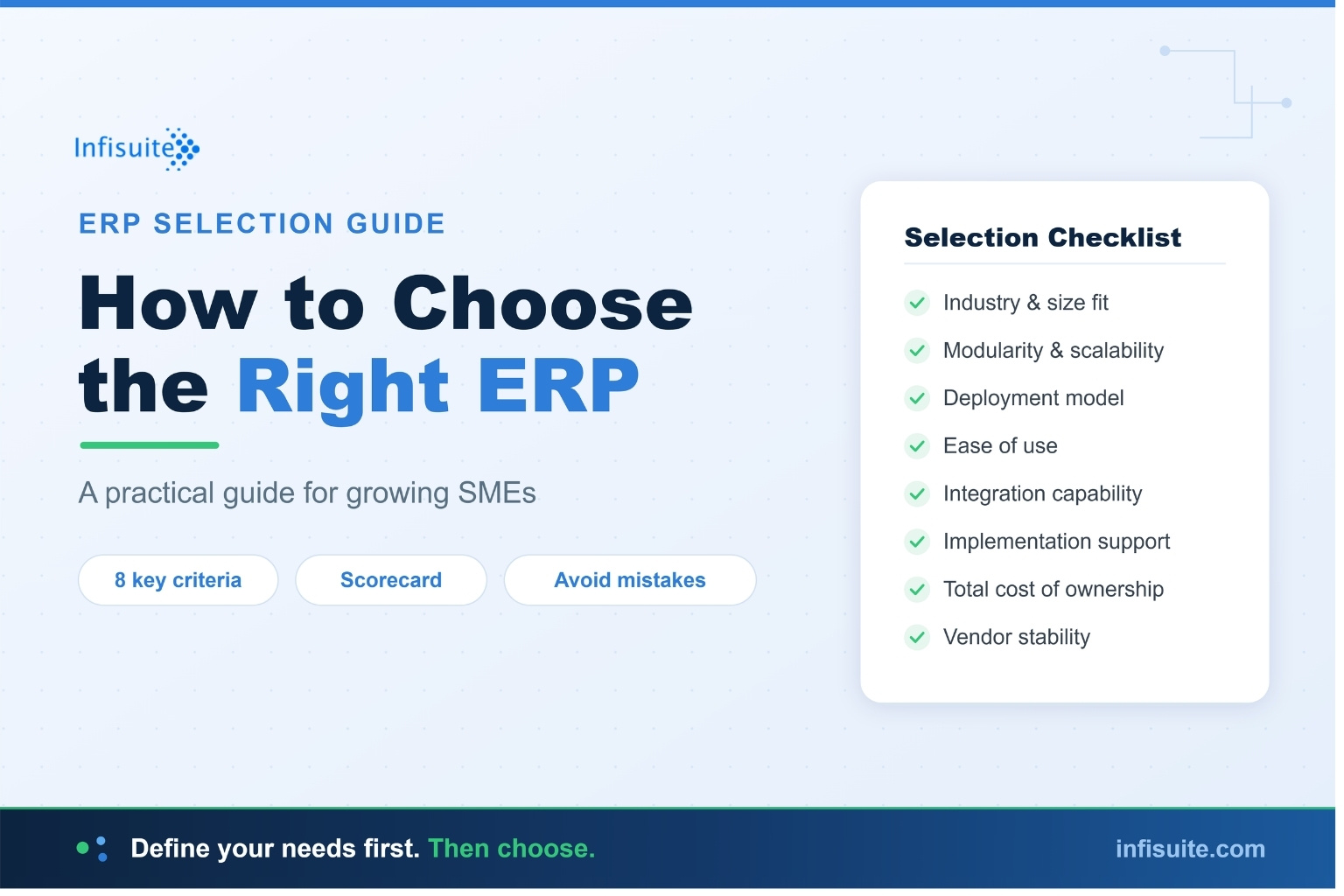
Not sure where to start? At Infisuite, we help businesses evaluate operational needs, scalability goals, and implementation strategies before selecting ERP solutions. Learn more about our ERP approach here.
Frequently Asked Questions
Is Cloud ERP secure enough for sensitive business data?
Yes. Reputable Cloud ERP providers use enterprise-level security standards — including GDPR and ISO 27001 compliance — that are often more robust than what most SMEs can maintain internally.
Can I migrate from Traditional ERP to Cloud ERP later?
Yes, migration is possible but requires careful planning. It’s better to evaluate your long-term needs upfront to avoid costly migrations later.
Which ERP has lower total cost of ownership?
For most SMEs, Cloud ERP has a lower total cost of ownership over 3–5 years. For large enterprises with existing infrastructure, Traditional ERP may be more cost-effective over 10+ years.
How long does Cloud ERP implementation take?
Cloud ERP implementations typically take a few weeks to a few months, depending on business complexity. Traditional ERP implementations can take 6 months to several years.
Conclusion
Both Cloud ERP and Traditional ERP are powerful systems — but they serve different business profiles.
Choose Cloud ERP if you want faster deployment, lower upfront costs, remote accessibility, and easy scalability without heavy IT investment.
Choose Traditional ERP if you need deep infrastructure control, advanced customization, and your industry requires internal data hosting.
The best ERP system is the one that aligns with your business size, growth strategy, compliance needs, and operational reality — not just today, but for the years ahead.
Want expert guidance on choosing the right ERP for your business? Explore Infisuite’s ERP solutions, learn how SMEs can start ERP without complexity, or understand why ERP implementations fail and how to prevent it.
Written by Anjana A
ERP & Business Software Specialist, Infisuite
Anjana A writes about ERP, business software, and automation for growing SMEs. Drawing on Infisuite’s experience helping businesses choose and deploy the right ERP model, she focuses on practical guidance for making confident, future-proof software decisions.