

Quick Answer
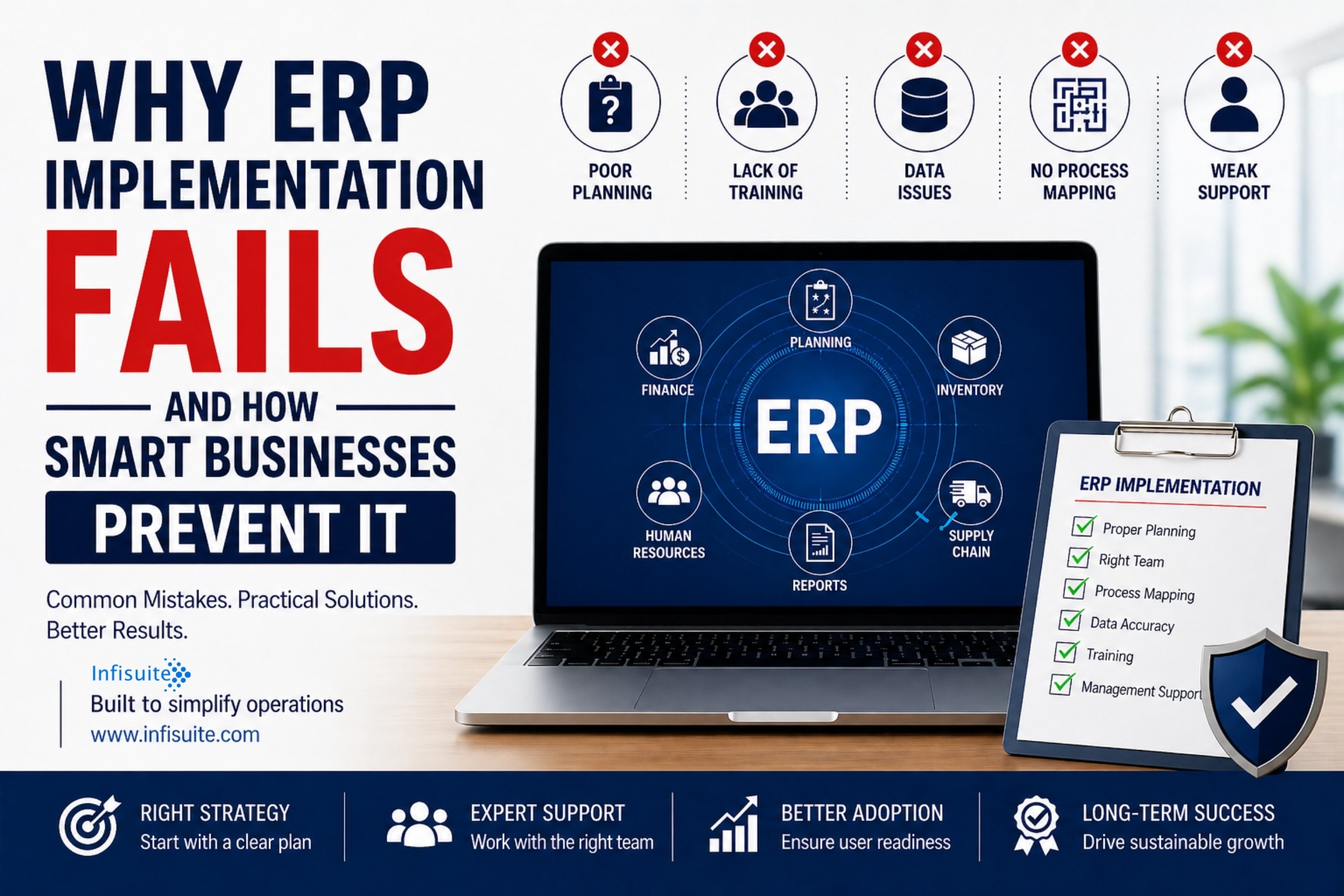
ERP implementations fail mostly because of execution, not software. The common causes are poor planning, choosing the wrong vendor, weak training, automating broken processes, dirty data migration, low leadership support, and unrealistic expectations. Studies suggest a majority of ERP projects miss their original goals. The good news: every one of these causes is preventable. A structured approach — clear objectives, the right partner, clean data, proper training, and phased rollout — is what turns ERP from a risk into a growth engine.
Key Takeaways
- ERP fails on execution, not software. The system is rarely the real problem.
- Planning is everything. Undefined goals are the number-one cause of failure.
- Never automate a broken process. Fix the workflow first, then automate it.
- Dirty data ruins good software. Clean and validate before you migrate.
- Every failure cause is preventable with a structured, phased approach.
Many businesses invest in ERP expecting immediate improvements in operations, reporting, and productivity. Yet a large number of ERP implementations fail — not because the software is ineffective, but because the execution strategy is flawed.
Industry research consistently shows that a majority of ERP projects — often cited as 55–75% — fail to meet their original objectives, according to analysis widely referenced from Gartner and other analysts. That’s a striking number. But the reasons are well understood, and every one of them is preventable.
ERP is not just software installation. It’s a business transformation. Without proper planning, the right partner, and strong internal alignment, ERP can create problems instead of solving them.
Here are the seven most common reasons ERP implementations fail — and exactly how to prevent each one.
1. Poor Planning Before Implementation
Many organizations begin ERP implementation without clearly defining their objectives. The warning signs are clear:
- No clear business goals
- Undefined department priorities
- Lack of measurable success criteria
This leads to delays, confusion, and budget overruns.
The fix: Create a detailed ERP roadmap. Cover your business goals, department needs, timelines, and responsibilities before anything else. Getting this right starts with knowing how to choose the right ERP for your needs.
2. Choosing the Wrong ERP Vendor
Selecting a vendor on cost alone is a major mistake. It leads to:
- Delayed implementation
- Poor customization
- Limited support
- Long-term inefficiencies
The fix: Choose a vendor with strong industry experience, reliable support, and a proven track record. The right partner matters as much as the right software.
3. Lack of Employee Training
ERP systems fail when employees aren’t comfortable using them. Poor training produces:
- Resistance to change
- Low adoption rates
- Reduced productivity
The fix: Start training before implementation. Provide practical, hands-on sessions. The most powerful ERP is worthless if your team won’t use it.
4. No Process Mapping Before Automation
Automating an inefficient process just makes the inefficiency faster. Many businesses replicate outdated workflows into ERP without improving them first.
The fix: Analyse and optimise your workflows before automation. Map how work actually flows, remove the waste, then automate the improved process — not the broken one.
5. Data Migration Issues
Poor data quality is one of the biggest reasons ERP systems fail. Common problems include:
- Duplicate records
- Incomplete data
- Inaccurate entries
The fix: Clean, validate, and test your data before migration. Dirty data moved into a new system doesn’t become clean — it becomes dirty data with a new interface. This is closely tied to the problems we cover in how data silos destroy operational efficiency.
6. Weak Management Support
ERP implementation requires leadership involvement. Without active management support, adoption slows and direction is lost.
The fix: Leadership must actively monitor progress and support the teams doing the work. ERP is a company-wide change, and it needs visible backing from the top.
7. Unrealistic Expectations
ERP is not an instant fix. Businesses expecting overnight results are often disappointed — and that disappointment can derail an otherwise sound project.
The fix: Treat ERP as a long-term investment delivered in phases. Expect steady, compounding improvements rather than an overnight transformation. This is also why understanding ERP ROI and its realistic timeline matters so much.
The Pattern Behind Every ERP Failure
Look closely, and all seven causes share one root: ERP is treated as a software project instead of a business transformation.
When you treat it as just installing software, you skip the planning, the process work, the training, and the change management that actually determine success. Research from McKinsey on digital transformation consistently links successful technology adoption to strong change management and leadership support. When you treat ERP as a transformation, you give those things the attention they need — and the software delivers.
How Infisuite Ensures ERP Success
Infisuite focuses on practical, business-driven ERP implementation:
- Industry-specific customisation — configured for how you actually work
- Structured implementation approach — clear phases, timelines, and milestones
- Comprehensive user training — so adoption is high from day one
- Secure data migration — cleaned and validated before go-live
- Continuous support — well beyond launch
It’s an approach built to prevent every common cause of failure — so your ERP becomes a genuine engine for growth.
Frequently Asked Questions
Why do most ERP implementations fail?
Most ERP implementations fail because of execution, not the software. The leading causes are poor planning, wrong vendor choice, weak training, automating broken processes, dirty data migration, low leadership support, and unrealistic expectations — all of which are preventable.
What is the biggest cause of ERP failure?
Poor planning is the most common root cause. When a business starts without clear goals, defined priorities, and measurable success criteria, the project drifts into delays, confusion, and budget overruns.
How can I prevent ERP implementation failure?
Prevent failure with a structured approach: define clear objectives, choose the right partner, optimise processes before automating, clean data before migration, train your team early, secure leadership support, and set realistic phased expectations.
Is ERP failure caused by the software?
Rarely. ERP failures are usually caused by how the system is implemented and adopted — not by the software itself. Treating ERP as a business transformation rather than a software installation is what makes the difference.
How long does a successful ERP implementation take?
It varies by scope, but a phased SME implementation typically runs over several weeks to a few months. Rushing the process is a common cause of failure — a structured, phased rollout delivers better, more durable results.
Conclusion
ERP implementation failures are rarely caused by the software itself. They happen because of poor planning, weak training, flawed execution, and unrealistic expectations.
Businesses that take a structured approach — and work with the right partner — unlock the full potential of ERP.
With the right strategy, ERP stops being a risk and becomes what it was always meant to be: a powerful tool for growth, efficiency, and long-term success.
Written by Anjana A
ERP & Business Software Specialist, Infisuite
Anjana A writes about ERP implementation, selection, and business automation for growing SMEs. Drawing on Infisuite’s experience guiding businesses through successful ERP rollouts, she focuses on practical, execution-first guidance that helps projects succeed.
Planning an ERP implementation and want to get it right the first time? Talk to the Infisuite team for a structured, business-driven approach.